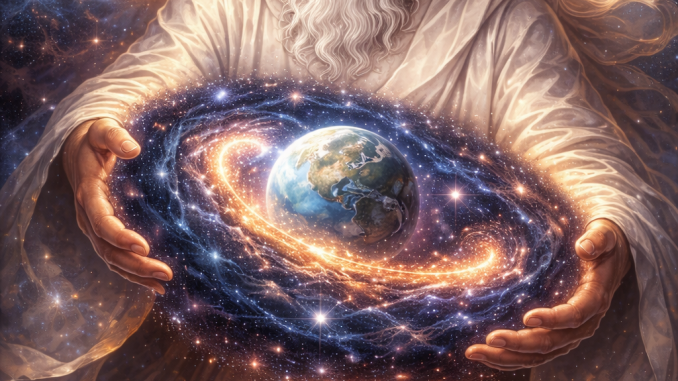
The statement in Genesis 1:1, “In the beginning God created the heavens and the earth,” is one of the most philosophically dense sentences ever written. It is not merely a poetic opening. It makes a metaphysical claim about the nature of reality itself.
“In the beginning” implies the origin of time. A “beginning” is not just a starting event within time, it is the commencement of time. If time begins at Genesis 1:1, then God logically exists prior to, and independent of, temporal sequence. That means God is not bound by past, present, and future. Rather, time itself is part of creation. In classical theology, this is described as divine eternity, not infinite duration, but existence outside duration altogether.
The phrase “created the heavens and the earth” is a Hebrew merism, meaning it refers to the totality of reality. “Heavens” can be understood as space, the expanse. “Earth” refers to material substance. Taken together, the verse claims that time, space, and matter came into existence through God’s act of creation. Modern cosmology, particularly Big Bang theory, is consistent with the concept that space and time themselves had a beginning. According to contemporary physics, spacetime is not eternal. It emerged approximately 13.8 billion years ago. If spacetime had a beginning, the cause of spacetime cannot itself be spatial or temporal.
This aligns with the theological claim that God transcends space and time. Transcendence here does not mean distance. It means ontological superiority. God is not located somewhere in the universe. The universe is contingent upon Him. If spacetime is a created framework, then God’s mode of existence must be non-spatial and non-temporal. He does not “exist” somewhere. He simply is.
The concept of God as pure energy is an attempt to articulate divine creative power in terms that resonate with physics. Einstein’s equation E = mc² demonstrates that matter is a condensed form of energy. Mass and energy are interchangeable. Matter is not fundamental. Energy is more fundamental. The equation reveals that an enormous amount of energy can be contained within even a small amount of matter. If matter can emerge from energy under the right conditions, then the creation of the universe from an immense, primordial energy state is not scientifically incoherent.
The theological claim is that God is not material. He is not composed of atoms, particles, or fields. Describing God as “pure energy” is metaphorical, yet it is philosophically suggestive. Energy in physics is the capacity to cause change or do work. It is invisible, yet its effects are observable. Similarly, Scripture describes God as spirit. Energy is not bound by the same limitations as solid matter. It can radiate, transform, and convert into mass. If the universe began in a state of incomprehensibly dense energy, then the idea that divine power initiated that reality becomes conceptually interesting.
However, one must be precise. God is not merely energy within the universe. That would reduce Him to a component of creation. Instead, if we extend the analogy carefully, God would be the source of all energy, the ground of being itself. Before matter, before radiation, before quantum fields, there was divine will. Creation, then, is the conversion of divine creative power into spacetime reality.
In this framework, Genesis 1:1 describes the initiation of time, space, matter, and energy. Modern physics confirms that matter is energy in structured form. Theologically, the universe can be seen as the structured expression of divine creative power. God transcends spacetime because He brought spacetime into existence. He permeates creation not as a physical substance, but as the sustaining cause of its continued existence.
To transcend time means that all moments are equally present to God. To transcend space means that God is not confined by dimensions. To create energy and matter means that the entire physical cosmos is derivative, contingent, and dependent. If E = mc² shows that matter is a manifestation of energy, then creation can be understood as the manifestation of divine power into a structured universe governed by laws.
Thus Genesis 1:1 can be read as both theological proclamation and metaphysical foundation: at the origin of time itself, an eternal, non-material, transcendent source brought forth the totality of spacetime reality. God exists outside the universe, yet sustains it. He is beyond it, yet active within it. Creation is not an event inside time. It is the origin of time.
Leave a Reply
You must be logged in to post a comment.