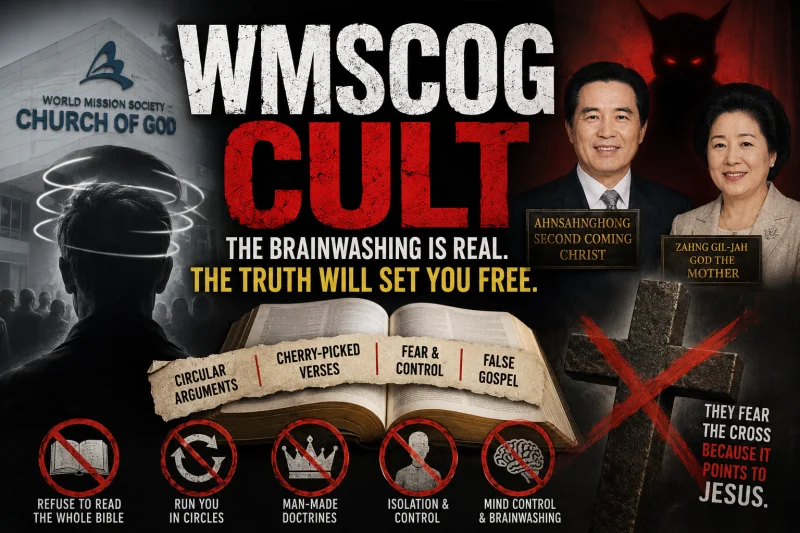
WMSCOG Teachings: Circular Arguments and a Gospel That Replaces Jesus
The World Mission Society Church of God, also known as WMSCOG, teaches that a Korean man named Ahnsahnghong was the Second Coming of Jesus Christ and that a Korean woman named Zahng Gil-jah is “God the Mother.” They also teach that salvation depends on keeping their version of the Passover, accepting Ahnsahnghong as the new name of Jesus, following their feast system, and believing their interpretation of verses about the fig tree, Jerusalem, Elohim, and the Bride in Revelation.
Why Discussions About WMSCOG Teachings Can Become Circular
After speaking with WMSCOG members over and over again, one thing becomes very clear: arguing with them can feel almost impossible. You can ask a simple question and somehow end up going through ten completely different Bible verses before the original question is ever answered. You mention the Lord’s Prayer, and instead of dealing with what Jesus actually said, the conversation suddenly becomes about the “new name.” You ask about the new name, and suddenly you are talking about Passover. You question Passover, and now you are talking about the fig tree. You question the fig tree, and suddenly you are hearing about King David.
This is what makes the conversations so frustrating. The discussion keeps moving in circles. Instead of answering one question directly, another teaching is used to protect the first teaching. Eventually you are back where you started. This pattern can be described as circular reasoning when the conclusion is repeatedly used to support the interpretation that was used to reach that conclusion.
Claims About Psychological Pressure and “Brainwashing”
When people use the word “brainwashing,” they sometimes imagine some kind of magical mind control. That is not what I mean. I am talking about strong psychological pressure, repetition, fear, isolation, controlling information, keeping people extremely busy, and teaching people that questioning the organization is the same as questioning God. These are criticisms and allegations that should be supported with specific, verifiable citations rather than presented as established facts about every WMSCOG member or congregation.
Former WMSCOG members have made serious allegations about practices associated with the church, including sleep deprivation, long hours of church activity, pressure to recruit, separation from friends and family, fear-based teachings, and attempts to control members’ thinking. Court cases and news reports have included some of these allegations, but they should be supported with specific citations and should not automatically be treated as proven facts in every case. The repeated accounts reported by former members warrant careful attention without presenting them as established findings.
In this discussion, “brainwashing” should not be understood to mean that a person becomes unintelligent. Intelligent people can become committed to controlling religious systems. The concern is that a member may learn to evaluate every question through the same approved framework. After repeated instruction, the member may respond to challenges by returning to a limited set of verses or interpretations rather than considering whether the underlying claim has been demonstrated.
That is the author’s personal observation from debates with WMSCOG members, not a conclusion about every individual member.
Why Is It So Hard to Get a Straight Answer?
A recurring criticism of WMSCOG arguments is that one teaching is used to establish another, and the second teaching is then used to support the first. This can create a circular argument.
Teaching or claim
For example, a WMSCOG member may say that Ahnsahnghong is God because he restored the Passover. If asked, “Where does the Bible say only God can restore Passover?” the response may turn to other prophecies that are believed to identify Ahnsahnghong as God.
Biblical critique
Those additional prophecies do not necessarily answer the specific question of where Scripture says that only God can restore the Passover. The reasoning can therefore become: Ahnsahnghong is God because he restored Passover, and only God can restore Passover because Ahnsahnghong is God.
That is circular reasoning: the conclusion is being used as evidence for the conclusion. A claim must be established independently rather than assumed in the argument intended to prove it.
Takeaway
When evaluating WMSCOG teachings, it is important to ask whether the cited text directly supports the claim or whether the interpretation depends on a conclusion that has already been assumed.
Jesus Taught Us to Pray to the Father
Teaching or claim
One clear example is the Lord’s Prayer, in which Jesus taught His followers how to pray.
Cited text
“Our Father in heaven, hallowed be your name.” — Matthew 6:9
Biblical critique
This instruction comes from Jesus Himself rather than from a church developed centuries later.
When this verse is presented to WMSCOG members, the response is often that Jesus taught it during the “Age of the Son,” while the present time is said to be the “Age of the Holy Spirit.” From that premise, they argue that Jesus has a new name.
Does Scripture End the Lord’s Prayer?
However, where does Jesus say that the Lord’s Prayer would expire? Where does He say that Christians would eventually stop praying to the Father and begin praying in the name of Ahnsahnghong?
There is no such verse.
Before Jesus left His disciples, He instructed them to continue teaching what He had commanded:
“Teaching them to obey everything I have commanded you.” — Matthew 28:20
From the author’s biblical interpretation, this continuing instruction does not provide a stated exception for replacing Jesus’ commands with the teachings of a later religious figure. The conclusion that prayer should instead be directed in the name of Ahnsahnghong therefore requires support beyond this passage.
Galatians 4:26 and the WMSCOG Teaching About “Heavenly Mother”
One passage frequently used in WMSCOG teachings is Galatians 4:26:
“But the Jerusalem that is above is free, and she is our mother.” — Galatians 4:26
WMSCOG interprets this verse as teaching the existence of a female God called “Heavenly Mother” and connects that teaching to Zahng Gil-jah.
The Cited Text and Its Immediate Context
The author’s criticism is that this interpretation does not account for Paul’s explanation two verses earlier:
“These things are being taken figuratively: The women represent two covenants.” — Galatians 4:24
Paul explicitly says that the women represent two covenants. In this passage, he does not say that they represent two Gods, that Sarah represents a Korean woman, or that Christians must worship “God the Mother.”
Why the Context Matters
Reading the whole chapter helps clarify Paul’s argument. If Galatians 4:26 is considered by itself, the reference to “mother” can be given a meaning that seems mysterious or literal. In the surrounding verses, however, Paul identifies the women figuratively with two covenants.
Accordingly, the author concludes that Galatians 4:26 does not, by itself, establish the WMSCOG teaching about a female deity. This is a criticism of the doctrine’s biblical interpretation rather than a claim about the personal intentions of every WMSCOG member.
Galatians 1 and the Importance of the Broader Argument
WMSCOG members may quote Galatians 4, but the author also asks readers to consider the message of Galatians 1 and how it bears on claims about later revelations or revised teachings.
“Even if we or an angel from heaven should preach a gospel other than the one we preached to you, let them be under God’s curse!” — Galatians 1:8
That is an important warning.
Elohim Does Not, by Itself, Prove God the Mother
Another major WMSCOG argument concerns the Hebrew word “Elohim.” WMSCOG teaching points to the word’s plural form and argues that it proves the existence of both God the Father and God the Mother.
In my assessment, that conclusion does not follow from the cited grammar or context.
Teaching or Claim: Elohim Requires a Father-and-Mother Interpretation
Consider the Bible’s first verse.
“In the beginning God created the heavens and the earth.” — Genesis 1:1
The word translated “God” is Elohim, but the Hebrew verb translated “created” is singular. The use of a plural-form noun therefore does not, by itself, establish two divine persons.
Cited Text: Genesis 1:27
Genesis 1:27 likewise says:
“So God created mankind in his own image, in the image of God he created them; male and female he created them.” — Genesis 1:27
The wording refers to his image and says that he created humanity. In this passage, the Bible uses Elohim while describing the Creator with singular pronouns.
Biblical Critique and Takeaway
Even if someone understands Elohim as suggesting some kind of plurality, that observation does not specify “Father and Mother.” Nor does it establish the identities of Ahnsahnghong and Zahng Gil-jah. The further conclusion that the word Elohim proves a Korean woman is God requires additional premises that are not demonstrated by the word alone.
The Bible Repeatedly Uses Singular Language for God
Teaching or Claim: Scripture Consistently Presents God as “He”
I have shown WMSCOG members verse after verse in which God is directly described as “He,” “Him,” “Father,” or as one God. There are hundreds of examples throughout Scripture.
Cited Texts: Psalm 100:3 and Deuteronomy 4:35
“Know that the LORD, He is God; It is He who has made us, and not we ourselves.” — Psalm 100:3
“To you it was shown, that you might know that the LORD Himself is God; there is none other besides Him.” — Deuteronomy 4:35
“I am the LORD, the Maker of all things, who stretches out the heavens, who spreads out the earth by myself.” — Isaiah 44:24
“I am the LORD, and there is no other; apart from me there is no God.” — Isaiah 45:5
“Do we not all have one Father? Did not one God create us?” — Malachi 2:10
WMSCOG Teachings and Biblical Statements About One God
The New Testament continues this language.
“Yet for us there is but one God, the Father, from whom all things came.” — 1 Corinthians 8:6
“One God and Father of all.” — Ephesians 4:6
“For there is one God and one mediator between God and mankind, the man Christ Jesus.” — 1 Timothy 2:5
Teaching or claim
WMSCOG teaches that God the Mother is an important biblical doctrine. From the author’s theological perspective, however, these direct statements about one God and Father present a significant challenge to that teaching.
Biblical critique
If God the Mother were truly one of the most important teachings in the Bible, why is she never clearly introduced? The author argues that WMSCOG has to build the doctrine from a few symbolic verses while giving less weight to hundreds of direct statements about God. This criticism should be evaluated by examining the context and interpretation of each passage rather than assuming the conclusion.
Takeaway
The cited passages explicitly emphasize one God, the Father. The author therefore concludes that they do not clearly support WMSCOG’s teaching about God the Mother.
John 1 Says Jesus Was There at Creation
The Gospel of John gives another serious problem for the WMSCOG creation argument.
“In the beginning was the Word, and the Word was with God, and the Word was God.” — John 1:1
Then John says:
“Through him all things were made; without him nothing was made that has been made.” — John 1:3
And later:
“The Word became flesh and made his dwelling among us.” — John 1:14
Teaching or claim
The author identifies the Word in these verses with Jesus and argues that John presents Christ as active in creation. On this reading, John does not introduce a Heavenly Mother.
Biblical critique
John explains creation through God and the Word who became Christ. Colossians presents a similar statement about Jesus.
“For in him all things were created.” — Colossians 1:16
Again, where is God the Mother? The author treats this as a challenge to the WMSCOG interpretation, while acknowledging that the conclusion depends on how the relevant passages are interpreted.
Takeaway
The cited texts directly connect creation with God and Christ rather than clearly identifying a female divine creator. They therefore do not, in the author’s view, establish the WMSCOG teaching about God the Mother.
The Bride in Revelation Does Not Mean a Female God
WMSCOG also uses Revelation 22:17.
“The Spirit and the bride say, ‘Come!’” — Revelation 22:17
Revelation’s Description of the Bride
Teaching or claim
WMSCOG teaches that the Spirit is God the Father and that the Bride is God the Mother.
Cited text
Revelation identifies the bride in the following passage:
“Come, I will show you the bride, the wife of the Lamb.” — Revelation 21:9
The next verse continues:
“And he carried me away in the Spirit to a mountain great and high, and showed me the Holy City, Jerusalem, coming down out of heaven from God.” — Revelation 21:10
Biblical critique
In this passage, the angel shows John New Jerusalem. John then describes a city with walls, gates, foundations, and measurements. The author’s interpretation is that the text does not explicitly identify the Bride as Zahng Gil-jah or state that the Bride is another God whom Christians must worship.
Takeaway
The connection between the Bride in Revelation and a particular modern person is an interpretation that requires support from the surrounding biblical text; Revelation 21:9–10 itself presents the Bride as the Holy City, Jerusalem, coming down from heaven.
The “New Name” Argument Does Not Name Ahnsahnghong
Teaching or claim
WMSCOG teaches that Jesus returned with a new name and that this new name is Ahnsahnghong. The church often appeals to Revelation 3:12.
Cited text
“I will write on them the name of my God and the name of the city of my God, the new Jerusalem ... and I will also write on them my new name.” — Revelation 3:12
Biblical critique
Read in context, Jesus says that the name will be written on the person who overcomes. The verse does not explicitly say, “My new name will be Ahnsahnghong.” It also does not state that Jesus will return as another Korean man or that Christians should stop trusting in the name of Jesus.
By contrast, Acts says:
“There is no other name under heaven given to mankind by which we must be saved.” — Acts 4:12
The author understands this passage to refer to Jesus Christ.
Takeaway
Revelation 3:12 mentions Jesus’ “new name,” but the verse does not supply the name Ahnsahnghong. Treating the phrase as a direct identification depends on an interpretive step rather than an explicit statement in the verse.
The Fig Tree Argument and the 1948 Timeline
Teaching or claim
WMSCOG teaches that the fig tree represents Israel, that Israel becoming a nation in 1948 began a prophetic timeline, and that Ahnsahnghong’s beginning his ministry around that time proves he was Christ.
Cited text
But Jesus said:
“Now learn this lesson from the fig tree: As soon as its twigs get tender and its leaves come out, you know that summer is near.” — Matthew 24:32
Luke’s parallel account reads:
“Look at the fig tree and all the trees.” — Luke 21:29
The Fig Tree Illustration and WMSCOG Teachings
Jesus refers to all the trees. The basic illustration is that changes in trees indicate that a season is approaching. Similarly, Jesus says that people should recognize what is approaching when they observe the signs he described.
In the author’s reading, these verses do not explicitly state:
“The fig tree means the modern nation of Israel.”
Nor do they state:
“Israel will become a nation in 1948.”
They also do not state:
“When that happens, a Korean man named Ahnsahnghong is Jesus.”
Teaching or Claim
The criticism presented here is that identifying the fig tree with modern Israel, assigning the fulfillment to 1948, and then connecting that interpretation to Ahnsahnghong involves adding conclusions that are not stated in Matthew 24:32 or Luke 21:29.
Biblical Critique and Takeaway
On this interpretation, the passage provides an illustration about recognizing signs, but it does not itself identify modern Israel, a specific year, or Ahnsahnghong. Those links would require additional argument rather than being direct statements of the cited verses.
The King David Calculation
Teaching or Claim
Another WMSCOG teaching says that King David ruled for forty years and that Jesus preached for about three years. From this, WMSCOG reasoning concludes that the Second Coming Christ needed to preach for the remaining thirty-seven years.
WMSCOG then connects that calculation with Ahnsahnghong by stating that his ministry lasted about thirty-seven years.
Biblical Critique
The passage under discussion does not identify a biblical text stating that David’s forty-year reign must be divided between Jesus and another person. It also does not state that Jesus must preach for three years, return later as another person, and preach for exactly thirty-seven additional years.
Takeaway
The author argues that this method appears to begin with Ahnsahnghong’s known life and ministry and then search the Bible for numbers that can be aligned with them. In that assessment, the reasoning is retrospective rather than a prophecy that independently predicts those events.
The Passover Argument and Circular Reasoning
Teaching or Claim
The Passover argument is commonly presented in this sequence: the true Passover disappeared; only God could restore it; Ahnsahnghong restored it; therefore Ahnsahnghong must be God.
Biblical Critique
The circular reasoning is in the conclusion: Ahnsahnghong’s restoration of Passover is first treated as evidence that he is God, while the claim that only God could restore Passover is used to support that conclusion. The question remains: where does Scripture say that whoever restores Passover must automatically be God?
Takeaway
Restoring or teaching a religious practice, by itself, does not establish the teacher’s divine identity unless the relevant biblical text explicitly makes that connection. The author’s criticism is therefore directed at the interpretive step linking Passover restoration to Ahnsahnghong’s identity.
Where is that verse?
There is none.
Jesus did celebrate Passover, and the Last Supper is important to Christian remembrance of Christ’s sacrifice.
Passover, Salvation, and WMSCOG Teachings
However, the author argues that WMSCOG goes further by presenting Passover as part of an exclusive salvation system in which its church is said to preserve the correct ceremony that other churches lost.
The New Testament is interpreted here as presenting salvation in simpler terms:
“For it is by grace you have been saved, through faith ... not by works.” — Ephesians 2:8-9
On this reading, the bread and wine point to Jesus rather than to a particular organization.
Foot Washing Does Not, by Itself, Establish a Church’s Authority
Jesus washed the disciples’ feet in John 13. WMSCOG places significant emphasis on this account and performs foot washing before Passover.
Jesus did say:
“I have set you an example that you should do as I have done for you.” — John 13:15
There is nothing inherently wrong with Christians washing one another’s feet. It can express humility and service.
However, the author finds no statement in this passage that an annual foot-washing ceremony proves a church is the only true church, or that people who do not perform it before a particular Passover ceremony cannot be saved.
In the same chapter, Jesus gives a broader command:
“Love one another. As I have loved you, so you must love one another.” — John 13:34
The author therefore understands the central lesson as humility, love, and service rather than institutional exclusivity.
Biblical Basis for WMSCOG’s Claims About the Father and Mother
The author raises questions about WMSCOG’s teaching that God the Father and God the Mother have appeared as Korean human beings.
Where does the Bible say that God the Father and God the Mother will both appear as Korean human beings?
Where does Scripture say one will be a man named Ahnsahnghong?
Where does Scripture say the other will be a woman named Zahng Gil-jah?
Where does Scripture say the Second Coming Christ will live another mortal life and die?
The author argues that these claims require explicit biblical support and states that the Bible instead presents the risen Jesus differently.
“Since Christ was raised from the dead, he cannot die again; death no longer has mastery over him.” — Romans 6:9
Jesus Himself says:
“I was dead, and now look, I am alive for ever and ever!” — Revelation 1:18
A Biblical Critique of the Claim That Jesus Returned as Another Mortal Person
From the author’s theological perspective, these verses raise a significant question for the WMSCOG teaching that Jesus returned as another mortal man who later died. If Jesus cannot die again, the author argues, that claim appears inconsistent with the cited passages.
The takeaway is that this criticism depends on comparing the doctrine with the Bible’s statements about Christ’s resurrection and continuing life, rather than treating the claim as established solely by an interpretation of selected verses.
The Bible Describes Jesus’ Return as Open and Unmistakable
The Bible does not describe the Second Coming as a hidden ministry that most of the world never notices. The following passages are commonly cited in criticism of interpretations that identify the Second Coming with an inconspicuous human ministry:
Acts says:
“This same Jesus ... will come back in the same way you have seen him go into heaven.” — Acts 1:11
Revelation says:
“Look, he is coming with the clouds, and every eye will see him.” — Revelation 1:7
Jesus Himself says:
“They will see the Son of Man coming on the clouds of heaven, with power and great glory.” — Matthew 24:30
First Thessalonians says:
“The Lord himself will come down from heaven.” — 1 Thessalonians 4:16
Cited Text and Takeaway
These verses describe the return of Jesus as public and unmistakable. The author therefore regards them as a biblical critique of the WMSCOG teaching about a concealed or ordinary human appearance. This is a theological interpretation, and readers should examine the surrounding context and the WMSCOG’s own explanation of these passages.
Using a Narrow Group of Proof Texts
The author reports repeatedly observing that WMSCOG members rely on a small group of verses in doctrinal discussions. That observation is presented as personal criticism, not as a conclusion about every member. The author’s concern is that reading the verses before and after a proof text may alter or qualify the proposed interpretation.
Teaching or Claim: “God the Mother”
Galatians 4:26 sounds useful for “God the Mother,” until Galatians 4:24 tells you the women represent two covenants.
Teaching or Claim: The Plural “Us” in Genesis
Genesis 1:26 sounds useful because God says “us,” until Genesis 1:27 says “his image” and “he created.”
Teaching or Claim: The Bride in Revelation
Revelation 22:17 sounds useful because it mentions the Bride, until Revelation 21 shows the Bride as New Jerusalem.
Takeaway: The author’s criticism is that these interpretations can become circular when a verse is selected to support a doctrine, while the doctrine is then used to determine the meaning of that same verse. Reading the surrounding context provides a way to test whether the interpretation is supported by the passage as a whole. Claims about how WMSCOG members are trained or how consistently they use these verses require supporting citations if presented as general factual allegations.
Matthew 24 mentions a fig tree, while Luke says “the fig tree and all the trees.”
Revelation 3 mentions a “new name,” but it never says the name is Ahnsahnghong.
For this reason, I tell WMSCOG members to consider more than the individual verse used to support a teaching.
Read the entire chapter.
Better yet, read the entire book.
The Cross in WMSCOG Teachings
Teaching or Claim
WMSCOG strongly criticizes the Christian cross and teaches that displaying it constitutes idol worship.
Biblical Critique
In mainstream Christian interpretation, Christians do not worship a piece of wood. The cross functions as a symbol.
A wedding ring represents marriage, but the ring itself is not the marriage. A photograph represents a person, but the photograph is not that person.
In the same way, the cross points Christians toward Jesus and His sacrifice.
The Bible repeatedly speaks positively about the cross.
“May I never boast except in the cross of our Lord Jesus Christ.” — Galatians 6:14
“The message of the cross ... to us who are being saved it is the power of God.” — 1 Corinthians 1:18
Paul also warns about people who become:
“Enemies of the cross of Christ.” — Philippians 3:18
Colossians says Jesus canceled our debt:
“Nailing it to the cross.” — Colossians 2:14
Ephesians says Jesus reconciled us to God:
“Through the cross.” — Ephesians 2:16
Takeaway
The cross is not God. Jesus is Lord. The cross serves as a reminder of what Jesus suffered and accomplished for Christians.
From the author’s theological perspective, this creates a significant question: why would a church teach people to fear the Christian cross while also teaching them to worship a Korean man and call a Korean woman “God the Mother”?
The author presents this comparison as a critique of WMSCOG doctrine and as a question about how religious symbols and claimed divine figures are distinguished. Determining whether either practice constitutes idolatry requires careful definition and engagement with the relevant biblical texts.
Why I Believe the Teaching Is Spiritually Dangerous
When I describe certain WMSCOG teachings as spiritually dangerous, I am not claiming that every member is demon-possessed. Many members may be sincere people who believe they are serving God. The criticism here concerns the teachings and interpretive system, not a judgment about every individual member.
Testing WMSCOG Teachings
The Bible warns that false religious teaching can appear spiritual and persuasive.
“Satan himself masquerades as an angel of light.” — 2 Corinthians 11:14
Paul also warned Christians about accepting a different Jesus and a different gospel.
First Timothy says:
“Some will abandon the faith and follow deceiving spirits and things taught by demons.” — 1 Timothy 4:1
John tells Christians:
“Do not believe every spirit, but test the spirits to see whether they are from God.” — 1 John 4:1
Teaching or Claim
From this perspective, Christians should test WMSCOG teachings rather than accept them solely because a speaker presents a chart linking many Bible verses or claims that one church alone understands the Bible.
Biblical Critique
The relevant question is whether each interpretation is supported by the biblical text in context. Readers should examine the passages themselves rather than relying only on the organization’s conclusions.
Takeaway
“Test the teaching” is a biblical principle. It calls for careful examination of WMSCOG teachings without assuming that sincerity proves an interpretation correct.
The Central Concern: Is Jesus Sufficient?
This is, in the author’s theological interpretation, the central concern with the WMSCOG system. Historic Christian teaching holds that salvation is found in Jesus Christ. The author argues that WMSCOG teachings add further requirements and identifications alongside Him.
Teaching or Claim
According to this criticism, WMSCOG requires:
- Jesus plus Ahnsahnghong.
- Jesus plus God the Mother.
- Jesus plus their Passover.
- Jesus plus their feast system.
- Jesus plus their interpretation of Elohim.
- Jesus plus their interpretation of the fig tree.
- Jesus plus their “new name.”
Biblical Critique
The author understands these additional teachings as making Jesus insufficient on His own. Jesus said:
“I am the way and the truth and the life. No one comes to the Father except through me.” — John 14:6
Jesus did not say through Ahnsahnghong.
Jesus did not say through Zahng Gil-jah.
Takeaway
The key theological question is whether these WMSCOG teachings preserve the biblical emphasis on access to the Father through Jesus or place additional figures, observances, and interpretations in a necessary role. That question should be evaluated by comparing the organization’s claims with the cited biblical texts in context.
Jesus did not say salvation comes through one particular organization. He said it comes through Me.
How to Discuss WMSCOG Teachings
Presenting many verses at once may not resolve a disagreement about WMSCOG teachings, particularly when a member responds by moving to another interpretation. A more focused approach is to ask one question at a time and examine the relevant passage in context.
Questions About Interpretation
Ask: If Galatians 4:24 says the women represent two covenants, where does Galatians say one woman represents Zahng Gil-jah?
Ask: Where does Revelation say the new name is Ahnsahnghong?
Ask: Where does the Bible say only God can restore Passover?
Ask: Where does Scripture say David’s forty years must be divided into three years for Jesus and thirty-seven years for another man?
Ask: Where does Scripture say the fig tree represents Israel becoming a nation in 1948?
Ask: If Romans 6:9 says Christ cannot die again, how could the returned Christ live another mortal life and die?
Ask: Where does the Bible directly identify Zahng Gil-jah as God?
These questions address specific interpretations rather than making a broad claim about every WMSCOG member. The discussion should remain with the question under consideration rather than shifting immediately to a different topic. The relevant passage should be answered and read in context first.
Conclusion: Read the Whole Bible
A practical safeguard against religious manipulation is to read the Bible independently and in context. This is a general principle of interpretation, not a substitute for examining each disputed teaching carefully.
Do not read only ten verses somebody selected for you.
Read what comes before them.
Read what comes after them.
Read the whole chapter.
Read the entire book.
Compare one teaching with the rest of Scripture.
If somebody tells you that questioning their church means questioning God, that should immediately concern you.
If somebody tells you that only their organization understands Scripture, that should concern you.
If somebody tells you that Jesus is not enough without their founder, their rituals, their calendar, their interpretation and their organization, that should concern you.
These statements describe concerns raised by the author about WMSCOG teachings; they should not be treated as universal claims about every individual member without supporting evidence.
The Bible never clearly says Ahnsahnghong is God.
The Bible never clearly says Zahng Gil-jah is God the Mother.
The Bible never says the new name of Jesus is Ahnsahnghong.
Testing WMSCOG Teachings Against the Biblical Text
The Bible does not explicitly say that the fig tree predicts Ahnsahnghong.
It also does not explicitly say that David’s forty-year reign predicts a thirty-seven-year Korean ministry.
Nor does the Bible state that restoring Passover proves that a particular person is God.
These conclusions appear only after WMSCOG’s interpretation is added to the cited passages. In this author’s critique, that approach risks circular reasoning: an interpretation is used to establish a conclusion, and the conclusion is then presented as confirmation of the interpretation.
Teaching or Claim
WMSCOG teachings connect biblical images, periods, and observances with Ahnsahnghong and use those connections to support claims about his identity.
Biblical Critique
The passages themselves do not state those conclusions directly. Readers should therefore examine the surrounding context, compare the interpretation with the whole Bible, and distinguish what the text says from what an interpreter infers from it.
“Dear friends, do not believe every spirit, but test the spirits to see whether they are from God.” — 1 John 4:1
Takeaway
Test the teaching.
Read the whole chapter.
Read the whole Bible.
And never be afraid to ask a question simply because somebody does not want to answer it. Concerns about controlling religious organizations or members’ experiences should be presented with specific, verifiable citations rather than as established facts without supporting evidence.
Comments
Leave a comment
No account is required. Your email address is required for payment/moderation records but is never displayed publicly. Comments are not eligible for approval until the $5.00 Stripe payment is verified, and payment does not guarantee approval.