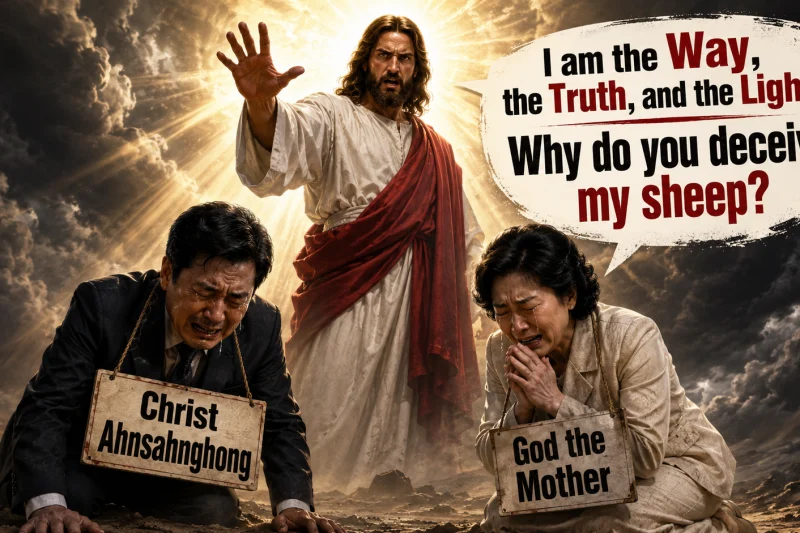
When a Church Feels Less Like God’s House and More Like Control
A while back, I was invited to visit what I expected to be a church. I went in with an open mind. I did not walk through the door looking for a fight, looking to insult anyone, or looking for material for a website. I went there expecting worship, prayer, fellowship, and a discussion about Scripture. I have spent enough time around Judaism, Christianity, Protestant theology, biblical history, and theological debate to understand that Christians are not going to agree on every doctrine. Some churches worship on Sunday. Some worship on Saturday. Some emphasize liturgy. Some emphasize spontaneous prayer. Some celebrate traditional Christian holidays and others do not. Those disagreements, by themselves, do not make a church dangerous or dishonest.
But regardless of denomination, a church should still feel like a church. It should be a place where someone can walk through the door, ask questions, open a Bible, disagree respectfully, pray, and leave without feeling that someone was attempting to pressure him into surrendering his independent judgment. A church should point a person toward God. It should not make the visitor feel as though salvation depends upon accepting an elaborate theological system before he is permitted to walk back out the door.
My experience with the World Mission Society Church of God, commonly known as the WMSCOG, did not feel that way.
What the World Mission Society Church of God Actually Teaches
This is not merely a disagreement over Saturday versus Sunday worship or whether Christians should celebrate Christmas. The World Mission Society Church of God teaches doctrines that go directly to the identity of God, the identity of Jesus Christ, salvation, prophecy, and the authority of Scripture. According to the church's own public materials, it teaches that Ahnsahnghong, a Korean religious leader who died in 1985, was the Second Coming Christ. The church also teaches the existence of "God the Mother," identifying the heavenly Jerusalem and the Bride of Revelation with a present divine Mother figure. Its official materials teach that Ahnsahnghong restored the New Covenant, that the Passover is necessary for eternal life, that the biblical Sabbath must be observed on Saturday, and that the church represents the restored Zion in which God's feasts are observed.
These are not allegations made by critics. They are doctrines the organization itself publicly promotes. The WMSCOG states that Ahnsahnghong established the Church of God in 1964 and that he fulfilled biblical prophecies concerning the Second Coming. Its materials also teach that "Elohim" demonstrates the existence of God the Father and God the Mother and that the Spirit and the Bride of Revelation 22 refer to God the Father and God the Mother. Those claims deserve serious examination because Christianity rises or falls on the identity of Christ. If somebody tells me that a man born in twentieth-century Korea was actually Jesus Christ returned to earth, I am going to require much more than a collection of creative interpretations and mathematical coincidences.
The Chicago Sun-Times reported in January 2026 that some former members have described the organization as a "doomsday cult" and have made allegations involving financial pressure, isolation from nonbelieving friends and family, failed end-times predictions, arranged marriages, and other troubling practices. The WMSCOG strongly disputes those characterizations and has stated that participation is voluntary and based upon personal conviction. Those competing claims should be represented accurately. I do not need to declare every allegation true in order to question the theology or describe what I personally experienced. Readers can examine the reporting and the church's response for themselves. See: Chicago Sun-Times: World Mission Society Church of God.
What I Experienced When I Walked In
Almost immediately, I felt pushed toward what they called Bible study. I have no objection to Bible study. I love studying Scripture. My problem was the manner in which it was presented. It did not feel like two people opening Scripture and examining what a passage actually says. It felt like I was being moved through a predetermined sequence in which every verse had already been assigned a special WMSCOG meaning and every question was designed to lead to the same destination.
The person speaking with me came across as aggressive and argumentative rather than pastoral. Instead of saying, "Here is what we believe, read it, study it, pray about it, and decide for yourself," the conversation felt increasingly like an effort to force a conclusion. Every objection produced another verse. Every challenge produced another prophecy. Every time one argument became questionable, another doctrine was stacked on top of it.
That was one of the first things that bothered me. Scripture started feeling less like Scripture and more like a theological scavenger hunt. A word from Genesis would be connected to a verse in Isaiah, which would be connected to a phrase in Revelation, which would then somehow land in South Korea in 1948. The conclusion was repeatedly inserted between verses instead of plainly stated by the verses themselves.
That distinction matters. There is a difference between studying the Bible and being taught how to reinterpret the Bible through an organization's doctrinal filter.
I Was Told Ahnsahnghong Was the Second Coming of Jesus
The central claim was that Ahnsahnghong was not simply a pastor, reformer, or religious teacher. He was supposedly the Second Coming Christ. That is an extraordinary claim. Christianity teaches that Jesus Christ was crucified, resurrected, ascended into heaven, and will return. Therefore, identifying another human being as that returning Christ carries an enormous burden of proof.
When I challenged this claim, I was presented with an expanding collection of arguments involving King David, the fig tree, Israel becoming a nation in 1948, Ahnsahnghong's baptism, a supposed thirty-year age requirement, thirty-seven additional years of ministry, Passover, Melchizedek, Cyrus, the East, clouds, Zion, the new name, the seal of God, and eventually God the Mother.
My problem was simple: none of those passages actually says, "The Second Coming Jesus will be a Korean man named Ahnsahnghong."
The name is never given in the Bible. The country is never named. His birth is never predicted. His parents are never named. His death in 1985 is never predicted. His church is never named. His supposed thirty-seven-year ministry is never stated. Instead, all of those conclusions have to be constructed after the fact.
The "King David" 40-Year Mathematics
One of the biggest arguments thrown at me was what the WMSCOG calls the prophecy of King David. Their official teaching begins with 2 Samuel 5:4, which says David became king at thirty and reigned for forty years. Jesus is connected with David's throne in the New Testament. From there, the WMSCOG argues that Jesus therefore had to conduct a forty-year gospel ministry.
Because Jesus' earthly ministry is commonly estimated at approximately three years, the calculation becomes 40 minus 3 equals 37. Then comes the conclusion: Jesus supposedly had to return in the flesh and preach for the remaining thirty-seven years. Ahnsahnghong is said to have begun his religious work in 1948 and continued until his death in 1985, which supplies the desired thirty-seven-year period.
This argument was repeatedly presented to me as though it were an explicit prophecy. It is not. Second Samuel tells us how long David ruled as king. It never says the Messiah must preach exactly forty years. It never says Jesus left thirty-seven years "unfinished." It never commands us to subtract the length of Jesus' first ministry from David's reign and assign the remainder to another earthly life of Christ.
The New Testament's connection between Jesus and David is about kingship and the Davidic promise. Luke 1:32-33 says that Jesus receives the throne of His father David and that His kingdom will have no end. That is considerably different from saying, "Jesus owes us another thirty-seven years of preaching because David ruled for forty."
Even more troubling was the argument I encountered that the Second Coming Christ therefore had to preach for thirty-seven years and then die. The New Testament says of the resurrected Christ that "death no longer has dominion over him" in Romans 6:9. Revelation 1:18 presents Christ as the one who died and is alive forevermore. Hebrews describes His priesthood as permanent. Turning David's forty-year reign into a mathematical requirement that Jesus must return, live another human life, and die again creates more theological problems than it solves.
The arithmetic may equal thirty-seven. Arithmetic alone does not create prophecy.
The 1948 Fig Tree Argument
Then I was given the fig tree argument. According to this interpretation, the fig tree in Matthew 24 represents Israel. Israel becoming an independent state in 1948 supposedly represents the fig tree coming back to life. Because Ahnsahnghong is said to have begun his ministry in 1948, the coincidence is presented as evidence that he was the Second Coming Christ.
The argument was taken even further: because Jesus began His ministry when He was "about thirty years old," the Second Coming Christ supposedly also had to be thirty in 1948. Ahnsahnghong's age is then fitted into the calculation.
But Jesus never says in Matthew 24, "When the modern State of Israel is established, find a thirty-year-old man being baptized in Korea." The parable says that when the fig tree's branches become tender and leaves appear, people recognize that summer is near. It is part of a larger discourse concerning signs and Christ's coming. Turning that illustration into an exact 1948 birth-age-baptism formula requires assumptions that are simply not written in the passage.
Jesus being about thirty when He began His public ministry also does not establish a universal messianic rule requiring every appearance of Christ to begin at exactly the same age. Luke reports Jesus' age. It does not announce an age test for detecting a future Korean messiah.
"Clouds Mean Flesh"
Another argument I encountered was that Christians misunderstand the Second Coming because the "clouds" are supposedly symbolic of human flesh. Therefore, when the Bible says Christ comes on the clouds, it allegedly means Christ appears as an ordinary human being.
Yes, the Bible uses symbols. Yes, apocalyptic literature contains imagery. But declaring that "cloud equals flesh" every time a prophecy becomes inconvenient is not responsible interpretation. Acts 1:9-11 specifically describes Jesus ascending and says that He will come in the same manner in which the disciples saw Him go into heaven. Daniel 7 uses clouds as extraordinary heavenly and royal imagery. The Gospels connect Christ's coming with power and glory.
And even if someone successfully demonstrated that one particular reference to clouds was symbolic, there would still be another enormous step missing. "Cloud is symbolic" does not logically equal "therefore Ahnsahnghong is Jesus." The argument has to prove the identity, not merely create enough ambiguity to insert the desired person into the prophecy.
I was even presented with the attempt to redefine "glory" in these passages as Passover. At some point, ordinary biblical vocabulary seems to stop being allowed to mean what it normally means. Clouds become flesh. Glory becomes Passover. Zion becomes one organization. The Bride becomes a particular woman. Jerusalem becomes a particular woman. The seal becomes Passover. Hidden manna becomes Passover. The East becomes South Korea. Then all of those newly assigned definitions are combined and presented as proof.
That is precisely why context matters.
The "Far East" and South Korea
The WMSCOG also teaches that biblical references to salvation or a figure coming "from the east" point to South Korea. Revelation 7:2 mentions an angel ascending from the east with the seal of the living God. Isaiah contains passages concerning figures arising from the east. These are then connected to Ahnsahnghong because he came from South Korea.
But "east" is not a synonym for "South Korea." Geography in biblical prophecy has a historical and literary context. Isaiah 41 and Isaiah 44-46 also contain material associated with Cyrus, the Persian king whom Isaiah actually names. Cyrus was a historical ruler used by God for a specific purpose involving Babylon and Israel. Turning every eastern figure into a coded prediction of a twentieth-century Korean religious leader ignores the fact that Isaiah tells us who Cyrus is.
The same problem exists with Revelation. Revelation 7 does not say, "The Messiah will be born in Korea." It describes an angel ascending from the east with God's seal. The WMSCOG first identifies the seal as Passover, then associates the supposed restoration of Passover with Korea, and finally concludes that the person restoring it must therefore be the Second Coming Christ. Each conclusion depends upon the conclusion before it. Remove one unsupported link and the chain collapses.
The Seal of God Is Supposedly Passover
I was also told that the seal of God in Revelation is the New Covenant Passover. Revelation 7 speaks about the servants of God being sealed. Yet the chapter itself never says that the seal is an annual Passover ceremony.
Elsewhere in the New Testament, sealing language is explicitly connected to the Holy Spirit. Ephesians 1:13 says believers were sealed with the promised Holy Spirit. Ephesians 4:30 similarly speaks about being sealed for the day of redemption. That does not make Passover meaningless. Passover has enormous biblical significance. But significance is not permission to redefine every other biblical symbol as Passover.
"The Tree of Life Is the Passover"
Another claim pushed at me was that the Tree of Life is the New Covenant Passover and therefore Passover is the only way to eternal life. The argument usually moves from Genesis to John 6, then to the Last Supper, and finally into the WMSCOG's annual Passover observance.
But John 6 centers eternal life on Jesus Christ Himself. Jesus is the bread of life. The chapter does not say, "The Tree of Life from Genesis is an annual ritual administered by the World Mission Society Church of God." Revelation later depicts the Tree of Life in the New Jerusalem. Once again, several different biblical images are being merged together until the desired doctrine appears.
I have no problem recognizing the importance of Passover. Jesus celebrated Passover. The Last Supper has Passover context. Christians have debated Eucharistic theology, Communion, and Passover for almost two thousand years. What does not follow is the leap from "Passover is biblical" to "therefore the man who taught our version of Passover is God."
"Only God Could Restore What God Established"
This became another recurring argument: Jesus established the New Covenant Passover, Sabbath, and biblical feasts. Those practices were supposedly lost or abolished. Ahnsahnghong restored them. Only God can restore something God originally established. Therefore, Ahnsahnghong must be God.
That sounds impressive until you examine the logic. Human beings restore religious practices constantly. Reformers study Scripture, conclude that previous generations abandoned something, and attempt to bring it back. One can agree or disagree with their interpretation, but restoration does not confer divinity.
If a pastor discovers an ancient Christian practice and reintroduces it, he does not become Jesus. If a Jewish scholar revives an old custom, he does not become Moses. If a theologian persuades a congregation to worship on Saturday, he does not become God. The claim "only God can restore God's teaching" is an assertion, not a biblical rule.
The Protestant Reformation itself was based largely upon the idea of returning Christianity to biblical foundations. Whether Luther, Calvin, Zwingli, or later restorationist movements got everything right is a separate issue. The mere act of attempting restoration cannot establish that the reformer is divine.
Passover, Foot Washing, and Salvation
I was repeatedly told that the correct New Covenant Passover has to be observed with the exact WMSCOG procedures, including foot washing, and I even encountered arguments suggesting that salvation or the validity of baptism depends upon accepting this system.
John 13 absolutely records Jesus washing His disciples' feet. It is a powerful lesson about humility and service. Christians differ over whether foot washing should be treated as a formal ordinance. But even if I accepted every WMSCOG argument about Passover and foot washing, it still would not prove that Ahnsahnghong was Christ.
That distinction is critical. A group could theoretically be correct about Saturday worship and completely wrong about the identity of God. It could be correct that Christians have neglected Passover and still be wrong that a Korean man was Jesus. It could correctly criticize commercialized Christmas traditions and still be wrong about God the Mother.
Truth is not sold as a package deal. Every doctrine has to stand on its own biblical evidence.
Sabbath, the Feasts, and "True Zion"
I was also told that Zion is defined as the place where God's feasts are kept and that because the WMSCOG observes the Sabbath and biblical feasts, it must therefore be the true Zion restored by God.
The Bible's theology of Zion is much larger than the headquarters or congregations of one twentieth-century religious organization. Zion is Jerusalem in the Old Testament. It develops prophetic and messianic significance. Hebrews 12:22 tells believers that they have come to Mount Zion and the heavenly Jerusalem. Revelation similarly develops the image of the New Jerusalem.
Micah 4 describes nations streaming to the mountain of the Lord as God's kingdom is established. Nothing in Micah identifies a South Korean organization founded in 1964.
I also encountered the argument that true worship itself consists of keeping the correct feasts and Sabbath. Yet Jesus tells the Samaritan woman in John 4 that the true worshipers will worship the Father in spirit and truth. The New Testament repeatedly focuses upon faith in Christ, repentance, love, holiness, mercy, and the work of the Spirit. A calendar can be meaningful. A calendar cannot replace Christ.
Melchizedek Was Turned Into Another Ahnsahnghong Prophecy
Another fascinating argument involved Melchizedek. Hebrews 7 describes Melchizedek as "without father or mother" and "without genealogy." The WMSCOG interprets this to mean that the Second Coming Christ must come from unbelieving parents and must not possess Jewish genealogy. Ahnsahnghong, being Korean and allegedly coming from a non-Christian family, is then said to fulfill the requirement.
That interpretation turns Hebrews into something it never says. The point of Hebrews is Melchizedek's priestly typology and the superiority of Christ's priesthood. The description concerns Melchizedek's literary presentation and priestly order. Hebrews does not say, "To identify the Second Coming, find a non-Jewish man whose parents do not believe in God."
The WMSCOG's own argument creates an additional problem when it says Jesus could not fully satisfy this portion because Mary and Joseph believed in God. The Gospels themselves present a much more complicated picture of Jesus' family. John 7:5 explicitly says His brothers did not believe in Him at that time, and Mark 3 records family tension surrounding His ministry. Biblical family history cannot simply be reduced to a convenient checklist designed around another man's biography.
The "New Name" of Jesus
Then came Revelation 3:12 and the claim that Jesus would have a "new name." The WMSCOG teaches that this new salvific name is Ahnsahnghong.
But Revelation 3:12 never says the new name is Ahnsahnghong. Revelation 2:17 also speaks about a new name in symbolic language connected with the victorious believer. Revelation contains repeated imagery involving names, authority, ownership, identity, and participation in God's kingdom. Simply locating the words "new name" does not provide permission to insert any later religious leader's name into the blank.
Acts 4:12 places salvation in Jesus Christ and says there is no other name under heaven given among mankind by which we must be saved. Philippians 2 says every knee will bow at the name of Jesus. If someone is going to argue that the saving name of Jesus effectively expired and was replaced in the twentieth century by the name Ahnsahnghong, that doctrine needs explicit biblical support. A verse containing the phrase "new name" is not enough.
Then Came "God the Mother"
If the Ahnsahnghong arguments were not already enough, I was then introduced to the doctrine of God the Mother.
One argument begins in Genesis 1:26, where God says, "Let us make mankind in our image." Because the Hebrew word Elohim has a plural grammatical form and humanity was created male and female, the WMSCOG concludes that there must be both God the Father and God the Mother.
That does not follow automatically from Hebrew grammar. Elohim can take plural forms in some contexts, but when referring to the God of Israel it frequently governs singular verbs and is treated as the singular God. The Hebrew Bible does not introduce a divine wife named God the Mother because Genesis uses the word Elohim.
Genesis 1:27 also does not say that the male human being was copied from a male deity and the female human being was copied from a female deity. It says humanity, male and female, was created in God's image. That is a theological statement about humanity's relationship to the Creator, not a description of God's reproductive anatomy.
"Every Living Thing Needs a Mother"
Another argument presented to me was essentially biological: every living thing receives life through a mother, therefore eternal life must also come through God the Mother.
That is an analogy, not biblical proof.
The New Testament explicitly says where eternal life is found. First John 5:11-12 says that God has given us eternal life and that this life is in His Son. Jesus says in John 14:6 that He is the way, the truth, and the life. The Gospel of John repeatedly directs people to Christ for eternal life.
Observing that mammals have mothers does not establish the existence of a second deity. Nature can illustrate theological ideas, but an illustration cannot manufacture a doctrine that the biblical text never plainly teaches.
Galatians 4:26: "Jerusalem Above Is Our Mother"
Galatians 4:26 was another favorite: "the Jerusalem above is free, and she is our mother." I was told this is direct biblical proof of God the Mother.
Except Paul tells us what he is doing in the chapter. He uses Hagar and Sarah allegorically to contrast two covenants. He contrasts slavery with freedom and the present Jerusalem with the Jerusalem above. The whole argument concerns covenant identity and the children of promise.
Paul never introduces a Korean woman who will appear almost two thousand years later and become a female member of the Godhead. The verse says Jerusalem. WMSCOG theology supplies the human identity afterward.
The Bride in Revelation
Revelation was then used to reinforce the same conclusion. Revelation 22:17 says, "The Spirit and the Bride say, Come." The WMSCOG identifies the Spirit as God the Father and the Bride as God the Mother.
But Revelation itself provides context for the Bride. Revelation 19 describes the marriage of the Lamb and says the Bride is clothed in fine linen, which is associated with the righteous deeds of God's people. Revelation 21:9-10 is even more direct. An angel tells John he will show him "the bride, the wife of the Lamb," and then shows him the Holy City, Jerusalem, coming down from heaven.
So when Revelation explains its own imagery, the Bride is connected with the redeemed people and the New Jerusalem. The text does not introduce a twentieth-century woman living in South Korea.
This is one of the recurring patterns I noticed. The WMSCOG tells you what a symbol means before allowing the surrounding chapter to tell you what it means.
Adam and Eve, the Last Adam, and a Supposed Last Eve
I also encountered typological arguments involving Adam and Eve. Jesus is connected to Adam typology in the New Testament, so the reasoning becomes: if there is a Last Adam, there must also be a Last Eve. The Last Adam is then connected to Ahnsahnghong and the supposed Last Eve to God the Mother.
But Romans 5 and 1 Corinthians 15 explicitly develop the Adam-Christ comparison. Scripture itself establishes that typology. There is no corresponding passage announcing a twentieth-century "Last Eve" who must be worshiped as God.
The fact that Adam had Eve does not authorize us to create a new deity for Jesus.
The Heavenly Wedding Banquet
Another argument involved the biblical wedding banquet, the Bride, and even Ahnsahnghong's final Passover gathering in a wedding hall. I encountered claims that details such as the wedding-hall setting and colored candles symbolized the prophetic wedding banquet and the revelation of Heavenly Mother.
This is exactly where theological interpretation can become unfalsifiable. Once ordinary circumstances surrounding a religious leader's life are treated as prophetic symbols, practically anything can become evidence. A meeting took place in a wedding hall, therefore it fulfills the heavenly wedding. Candles had particular colors, therefore they carry prophetic significance. The conclusion is already assumed, and then ordinary details are retroactively transformed into signs.
Where does Scripture predict the building? Where does Scripture predict the candles? Where does Scripture identify those details as signs of the Second Coming? If those elements are not actually in the prophecy, they cannot reasonably be presented as fulfillment of the prophecy.
The Cross Was Supposedly Idolatry
I was also confronted with the argument that mainstream Christianity is false because churches display the cross. The WMSCOG compares the Christian use of the cross with the bronze serpent from the Old Testament. Because the bronze serpent eventually became an object of idolatrous worship and had to be destroyed, the claim is made that the cross similarly became an idol.
The biblical prohibition is against idolatry and worshiping created things as gods. That does not mean every religious symbol is automatically an idol. In 2 Kings 18:4, the bronze serpent became a problem specifically because people were burning incense to it. The abuse of an object does not establish that every symbolic object is inherently idolatrous.
Christians do not generally believe that two pieces of wood are God. The cross represents the crucifixion and sacrifice of Christ. Paul himself repeatedly uses the cross as central Christian imagery. First Corinthians speaks of the message of the cross, and Galatians 6:14 says Paul boasts in the cross of our Lord Jesus Christ.
One may personally choose not to display a cross. That is entirely different from declaring millions of Christians idolaters merely because a cross appears inside a church.
Sunday, Christmas, Easter, and "Pagan Christianity"
Arguments concerning Sunday worship, Easter, and Christmas were also used to establish the idea that almost all of historic Christianity fell into apostasy while the WMSCOG alone restored authentic Christianity.
I am perfectly willing to discuss the historical development of Christian holidays. Some later customs obviously are not commanded in Scripture. Christmas on December 25 is not a biblical command. Easter traditions developed historically. Christians disagree about the Sabbath. Those are legitimate historical and theological discussions.
But disproving Santa Claus does not prove Ahnsahnghong is Jesus.
Showing that a church adopted an unbiblical custom does not establish God the Mother. Showing that Constantine influenced Christian history does not establish that South Korea is the prophetic East. Showing that modern Christians may have neglected Passover does not prove that the man who taught Passover was Almighty God.
Again, each claim must stand on its own evidence.
The Council of Nicaea and the Claim That Passover Disappeared
I was repeatedly told that the New Covenant Passover was abolished at the Council of Nicaea in A.D. 325 and disappeared from Christianity until Ahnsahnghong restored it.
The history is substantially more complicated than that slogan suggests. Early Christianity certainly had disputes about the timing of Pascha and the Quartodeciman controversy. Nicaea addressed the dating of the Christian Paschal celebration. But describing the council simply as "Constantine abolished Jesus' Passover and nobody kept it for 1,600 years until Ahnsahnghong" compresses centuries of complicated Christian liturgical history into a convenient restoration narrative.
Even if someone accepts the WMSCOG's historical argument completely, however, the theological problem remains. Restoring a religious observance does not make the person restoring it God.
The 144,000, the Great Multitude, and Fear-Based Exclusivity
Another subject that came up was Revelation's 144,000 and God's sealed people. What disturbed me was the repeated emphasis on who supposedly will not be saved, as though Christianity were primarily about determining who gets excluded from God's kingdom.
But Revelation 7 does not stop after the 144,000. Immediately afterward, John sees a great multitude that nobody can number, from every nation, tribe, people, and language, standing before the throne and before the Lamb.
That is an enormous part of the picture. Whatever one's interpretation of the 144,000, Revelation itself refuses to let the reader reduce God's redeemed people to a tiny private organization.
The Gospel is much bigger than organizational membership.
"Only the Chosen Can Understand"
When complicated doctrines are challenged, another response I have heard is that only God's chosen people can understand the prophecies. If someone does not accept the WMSCOG interpretation, the failure supposedly demonstrates that God has not opened that person's spiritual eyes.
That is a dangerous argument because it makes a doctrine almost impossible to question. If you agree, the church is correct. If you disagree, your disagreement becomes evidence that the church is correct because you supposedly are not chosen to understand.
That is circular reasoning.
Acts 17 praises the Bereans for examining the Scriptures daily to determine whether what they were being taught was true. First John 4:1 tells believers to test the spirits. Galatians 1 warns against accepting another gospel even if presented by an impressive messenger.
Biblical faith does not require turning off your ability to ask questions.
"You're a Pharisee If You Don't Believe Us"
During these debates I have also encountered arguments that people who reject Ahnsahnghong are modern Pharisees, do not understand prophecy, are not God's people, or even belong to the devil. At that point, theological discussion stops being theological discussion and becomes intimidation.
Calling someone a Pharisee does not prove your interpretation of Matthew 24. Telling someone that his heart belongs to the devil does not prove a thirty-seven-year prophecy. Telling someone God has blinded him does not prove God the Mother.
Those are personal attacks used in place of evidence.
If a doctrine is true, it should survive questions.
"You Cannot Limit God"
Another argument I was given was that God is all-powerful and therefore God could come to earth as a man, a woman, or even multiple people. I was told that denying such possibilities would be "limiting God."
That argument confuses possibility with proof.
Could an all-powerful God theoretically manifest Himself however He chooses? That philosophical question is different from asking whether God actually revealed in Scripture that a particular Korean man and Korean woman are divine.
I am not obligated to worship every person someone claims God could theoretically inhabit. Christianity does not operate on the standard of "God could do it, therefore this person is God." Scripture identifies Christ through positive revelation.
God's omnipotence is not a blank check for every new religious claim.
The Argument Kept Growing
This is what ultimately amazed me about the experience and the conversations that followed. The claim did not stand upon one plain prophecy. It required an entire interconnected system.
I was asked to accept that King David's forty-year reign secretly creates a forty-year messianic ministry. Then I had to accept that Jesus completed only three years of it. Then I had to accept that the missing thirty-seven years required another earthly ministry. Then 1948 had to be identified through the fig tree. Then Jesus being approximately thirty had to become a prophetic age requirement. Then the East had to become South Korea. Then clouds had to become flesh. Then the seal had to become Passover. Then hidden manna had to become Passover. Then Zion had to become the church that keeps the feasts. Then Revelation's new name had to become Ahnsahnghong. Then Melchizedek's lack of genealogy had to mean a non-Jewish Korean. Then Elohim had to mean Father and Mother. Then Jerusalem had to become a woman. Then the Bride had to become the same woman. Then biological motherhood had to become evidence of a female deity.
At some point I had to ask a very basic question: if the Bible is supposedly so clear about all of this, why does every step require somebody from the organization to explain what the words secretly mean?
Jesus Should Be the Center of Christianity
I lean strongly toward Protestant Christianity, with an appreciation for the Jewish roots of the faith. I came from a Jewish background, so I am certainly not hostile to Sabbath, Passover, Hebrew Scripture, or the biblical feasts. Jesus was Jewish. His disciples were Jewish. The earliest Christian movement emerged from the Jewish world. Jesus participated in Jewish festivals. Christianity cannot be intelligently understood while pretending the Old Testament does not exist.
But the New Testament does something very specific with all of that history: it centers it on Jesus Christ.
Jesus is the Messiah. Jesus is crucified. Jesus is resurrected. Jesus ascends. Jesus lives forever. Jesus is the mediator. Jesus is the Lamb. Jesus is the one through whom salvation comes. Jesus is the one whose return Christians await.
The more someone tries to convince me that I need to move my focus away from Jesus of Nazareth and onto another human being, the more carefully I am going to examine the claim.
The Prayer Itself Felt Wrong to Me
Even the prayer at the beginning of my visit left me uncomfortable. Silent prayer itself is not inherently wrong. Christians pray silently all the time. My concern was the context. I was entering a religious organization that I soon learned believed in Ahnsahnghong and God the Mother, yet the prayer was not openly identified in a way that allowed me to know to whom it was being directed.
When Christians pray together, there is normally no mystery about the object of prayer. We pray to God. Christians commonly pray in the name of Jesus. We may recite the Lord's Prayer. We may pray spontaneously. But there should be no theological shell game in which a visitor has to wonder whether he has unknowingly participated in prayer directed toward people he does not recognize as God.
Given everything that followed, that bothered me.
How I Felt When I Walked Out
When I finally left, I did not feel spiritually refreshed. I did not feel that I had spent time with people gently guiding me toward Jesus Christ. I felt relieved to be outside.
That reaction stayed with me.
I later texted the person I had spoken with. The response struck me as cold and dismissive. I told him sincerely that I would pray for him. I was not saying it sarcastically. I meant it. What concerned me was how little room there appeared to be for the possibility that somebody could sincerely love God, read Scripture, seek Christ, and still conclude that the WMSCOG's interpretation was wrong.
A religious disagreement should not automatically turn the other person into an enemy of God.
Why I Created WMSCOG-Truth.com
That experience did not make me want to stop studying the subject. It did the opposite.
The more arguments I heard, the more Scripture I opened. I began checking the verses in context instead of simply accepting the interpretation attached to them. I compared Genesis with John. I compared Galatians 4 with the entire argument Paul was making about Hagar, Sarah, and the covenants. I read Revelation 19, 21, and 22 together instead of isolating the word "Bride." I compared Revelation's sealing language with Ephesians. I read Hebrews 7 in its actual discussion of Melchizedek. I looked at 2 Samuel before accepting the claim that David's reign created a thirty-seven-year Second Coming countdown.
Eventually, there were so many claims, counterarguments, verses, historical issues, and recurring conversations that I decided to organize the research publicly.
That became WMSCOG-Truth.com.
WMSCOG-Truth.com is an independent Christian Bible-study resource created to examine World Mission Society Church of God doctrines against Scripture. It is not affiliated with the WMSCOG. The purpose is not to tell people what to think simply because I said so. In fact, the entire point is the opposite: open the Bible, read the chapter, examine the context, compare Scripture with Scripture, and test the claim yourself.
The site examines the identity of the biblical Jesus, the claim that Ahnsahnghong was the Second Coming Christ, the "new name" doctrine, God the Mother, Elohim, Genesis 1:26, Galatians 4:26, the Bride of Revelation, Passover, Sabbath, the biblical feasts, Zion, Jerusalem, the cross, baptism, Melchizedek, King David, the thirty-seven-year argument, the 1948 fig-tree argument, prophecy from the East, the seal of God, the 144,000, and other recurring WMSCOG teachings.
It also addresses a distinction that I think gets lost in these debates: something can be biblical without proving the WMSCOG. Sabbath is biblical. Passover is biblical. The biblical feasts are biblical. Jerusalem is biblical. Zion is biblical. Melchizedek is biblical. King David is biblical. The Bride is biblical. The Tree of Life is biblical. The problem begins when all of those subjects are redefined so that they ultimately point to two modern people in South Korea.
A Resource in Multiple Languages
I also wanted the information to be accessible beyond English-speaking readers. WMSCOG-Truth.com provides material in multiple languages, including English, Spanish, Korean, and Russian, so people from different backgrounds can examine the same fundamental questions.
The site includes direct Bible comparisons, explanations of individual doctrines, discussions concerning biblical interpretation, information about the true Jesus of the New Testament, sections dealing with Ahnsahnghong and God the Mother, material concerning Passover and Sabbath, discussions of the cross and idolatry, Jerusalem and Zion, and a self-study quiz designed to make readers actually compare the claims with the biblical text.
The objective is not personal hatred toward WMSCOG members. Many members appear completely sincere. Sincerity is precisely why theological scrutiny matters. People can sincerely believe something that is wrong. I can be wrong too. The solution is not to scream louder. The solution is to return to Scripture and permit the text to correct all of us.
Read the Scripture Before Accepting the Interpretation
That became one of the fundamental principles behind the site: read what the passage says before someone tells you what it secretly means.
If someone says "Elohim means God the Father and God the Mother," read Genesis and the rest of the Hebrew Bible.
If someone says "Jerusalem is God the Mother," read Galatians 4 from the beginning of the argument through the end.
If someone says "the Bride is God the Mother," read Revelation 19, Revelation 21, and Revelation 22 together.
If someone says "King David proves thirty-seven years," read 2 Samuel 5 and then ask where the New Testament commands the subtraction.
If someone says "the fig tree means Israel became a nation in 1948 and therefore Ahnsahnghong had to be baptized that year," read Matthew 24 and ask where Jesus provides those instructions.
If someone says "cloud means flesh," compare the passages about Christ's return instead of accepting a newly assigned dictionary definition.
If someone says "the East means South Korea," read Isaiah's actual discussion of Cyrus and read Revelation in context.
If someone says "the seal is Passover," examine what the New Testament explicitly calls a seal.
If someone says "the new name is Ahnsahnghong," ask them to show you the verse containing that name.
If someone says "only God could restore Passover," ask them to show you the verse establishing that rule.
If someone says questioning these teachings proves you are a Pharisee, remember that Acts 17 praises people for checking what they were taught against Scripture.
I Am Not Arguing Against Passover, Sabbath, or the Old Testament
This is another point that deserves emphasis because it is easy to misrepresent criticism of the WMSCOG as criticism of everything the organization practices.
I am not arguing that Passover is evil. It is biblical.
I am not arguing that the Sabbath is evil. It is biblical.
I am not arguing that Christians should ignore the Old Testament. That would make Christianity almost unintelligible.
I am not arguing that modern Christian traditions are automatically correct simply because they are old or popular.
I am arguing that none of those subjects proves Ahnsahnghong is Jesus Christ.
If tomorrow every Christian church on earth began observing Passover, that would not make Ahnsahnghong divine. If every church moved worship to Saturday, that would not make Zahng Gil-jah God the Mother. If every Christmas tree disappeared tomorrow morning, Revelation 3:12 still would not contain the name Ahnsahnghong.
That is the distinction I repeatedly felt was missing from the arguments presented to me.
The Gospel Should Not Require a Secret Decoder Ring
Christian theology can certainly be complicated. Scholars have debated difficult passages for centuries. Revelation is filled with symbolism. Daniel is complicated. Hebrews assumes extensive knowledge of the Old Testament. Nobody should pretend every verse is simple.
But there is something very different about complexity arising naturally from Scripture and complexity created because an organization needs twenty separate verses to establish something the Bible never plainly says.
If every symbol has to be reassigned, every historical event has to be fitted into a timeline, every number has to become a formula, and every objection produces another layer of interpretation, eventually the system can become self-protecting. Any fact can be absorbed into it.
That is not how I want to approach Scripture.
I would rather begin with the clearest passages and work outward. Jesus Christ died for sins. He was raised. He lives. Salvation is through Him. Christians are called to repentance, faith, holiness, mercy, love, and truth. We are told to test teachings. We are warned about false christs. We are told not to be deceived.
"Many Will Come in My Name"
Matthew 24:5 kept returning to my mind throughout this experience because Jesus warned that many would come in His name and claim messianic authority.
That does not mean we should scream "false prophet" at every person with whom we disagree. It means claims about the identity of Christ should be treated with extraordinary seriousness.
If somebody tells me Jesus returned and I somehow missed it, I am going to investigate.
If somebody tells me His new name is now the name of a different human being, I am going to investigate.
If somebody tells me a living woman is God the Mother, I am going to investigate.
If somebody tells me my salvation depends upon joining the organization that teaches those doctrines, I am definitely going to investigate.
That investigation is not rebellion against God. It is exactly what Scripture tells believers to do.
What a Church Should Feel Like
A healthy church should not be afraid of questions. It should not panic when somebody says, "Show me where the Bible actually says that." It should not need to frighten a visitor with claims that virtually everyone outside the organization is condemned. It should not treat disagreement as proof of spiritual blindness.
A church should teach.
It should pray.
It should serve.
It should encourage repentance.
It should comfort people who are hurting.
It should point continually toward God and Jesus Christ rather than requiring people to accept an organization as the gateway through which God must be approached.
Why I Continue to Speak About It
I created WMSCOG-Truth.com because the arguments did not stop after I left the building. They continued through conversations, messages, debates, and repeated attempts to persuade me that one more prophecy would finally make everything fit.
I have heard King David.
I have heard the missing thirty-seven years.
I have heard 1948 and the fig tree.
I have heard the thirty-year-old baptism argument.
I have heard clouds equal flesh.
I have heard glory reinterpreted through Passover.
I have heard South Korea and the East.
I have heard Cyrus.
I have heard Melchizedek.
I have heard the seal of God.
I have heard the Tree of Life.
I have heard Passover.
I have heard foot washing.
I have heard Sabbath.
I have heard the seven feasts.
I have heard Zion.
I have heard the "new name."
I have heard Elohim.
I have heard Genesis 1:26.
I have heard Galatians 4:26.
I have heard Jerusalem our Mother.
I have heard the Spirit and the Bride.
I have heard Adam and Eve.
I have heard the heavenly wedding banquet.
I have heard the wedding hall and the candles.
I have heard the 144,000 and the sealed people.
I have heard the cross called an idol.
I have heard Sunday called pagan.
I have heard Christianity described as having essentially lost the truth until Ahnsahnghong restored it.
I have heard that only God could restore what God established.
I have heard that rejecting these interpretations means I do not understand prophecy.
I have heard that refusing to accept Ahnsahnghong makes someone a modern Pharisee.
I have even heard the argument that questioning the doctrine shows that a person's heart does not belong to God.
After hearing all of it, my answer remains the same: show me the Scripture in context.
My Conclusion
I originally walked into the WMSCOG expecting to visit a church. Instead, I walked out with more questions about the organization than I had when I entered.
Those questions eventually became research. The research became debates. The debates became pages of notes. The notes eventually became WMSCOG-Truth.com.
I do not expect everybody to agree with every conclusion on the website. That is not the point. The point is to make the claims testable. Do not accept WMSCOG doctrine merely because a teacher rapidly flips through twenty Bible verses. Do not reject it merely because somebody on the Internet calls the organization a cult. Read the passages. Examine the context. Study the history. Compare the claims with the teachings of Jesus and the apostles. Then decide.
For me, the central question remains remarkably simple.
Does Scripture actually teach that Ahnsahnghong is Jesus Christ returned in the flesh and that Zahng Gil-jah is God the Mother?
After examining the King David calculation, the 1948 fig-tree argument, the East, Melchizedek, the new name, Passover, the seal, Zion, Elohim, Galatians, Revelation's Bride, and the other arguments presented to me, I do not believe the Bible establishes either claim.
And if a religious organization wants me to worship human beings as God, "close enough" is not good enough.
A church should bring people closer to God, not make them afraid to question an organization.
A church should teach Scripture, not make Scripture dependent upon an organizational decoder.
A church should point to Christ, not require another human being to stand in His place.
A church should feel like prayer, fellowship, humility, truth, mercy, and love.
It should feel like the Lord's house.
My experience did not.
That is why I kept studying.
That is why I kept asking questions.
And that is why I created WMSCOG-Truth.com.
Комментарии
Оставить комментарий
No account is required. Your email address is required for payment/moderation records but is never displayed publicly. Comments are not eligible for approval until the $5.00 Stripe payment is verified, and payment does not guarantee approval.