If Faith Saves Us, What Is the Purpose of Worship?
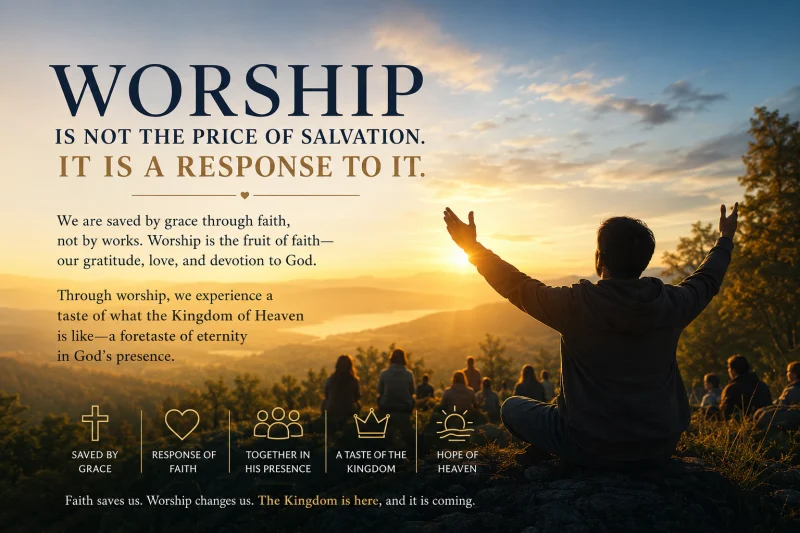
If salvation comes through faith, then it is fair to ask why worship matters at all. If a person is saved by God's grace through faith, why pray, attend worship, sing, gather with other believers, read Scripture, take communion, or participate in religious practices? The answer is that worship is not supposed to be a payment for salvation. Worship is the natural response of a person who already believes in God. We do not worship in order to purchase eternal life. We worship because we trust God, love Him, are grateful to Him, and want to draw closer to Him.
The New Testament repeatedly places salvation in God's grace rather than in human religious performance. Ephesians 2:8-9 says, "For it is by grace you have been saved, through faith," and immediately explains that this is "not by works, so that no one can boast." That does not make works, obedience, or worship meaningless. In fact, the next verse says that believers were created in Christ Jesus to do good works. The order is important. Good works are supposed to grow out of faith. Worship grows out of faith. Obedience grows out of faith. They are the fruit of a relationship with God, not the price someone pays to enter that relationship.
Think about any real relationship. If you truly love someone, you normally want to spend time with that person. You speak to them, listen to them, appreciate them, and want to remain close to them. A healthy relationship is not based on completing a checklist so that the other person is forced to love you. In the same way, Christian worship should not be treated like a religious transaction where someone performs the correct ceremony and God is then obligated to give that person salvation. Worship should come from faith, gratitude, love, reverence, and a desire to know God more deeply.
Worship also has another purpose that is often overlooked. In a very real sense, worship can give believers a small taste of what the Kingdom of Heaven is supposed to be like. The Bible describes heaven as a place where God's people are in His presence, where attention is directed toward Him, and where worship, gratitude, peace, and joy are central. Revelation describes people from every nation standing before God and praising Him. It describes heavenly beings worshiping before His throne, and it ultimately describes God dwelling with His people.
When Christians gather sincerely to pray, sing, hear Scripture, encourage one another, forgive one another, and focus on God, they are experiencing a small preview of that future reality. A church building is obviously not heaven, and the people inside it are certainly not perfect. People still have problems, disagreements, worries, jobs, bills, and ordinary human weaknesses. Yet during genuine worship, attention can temporarily shift away from all of those things and toward something greater. People remember God, forgiveness, hope, mercy, eternal life, and the promise of His Kingdom. In that sense, worship becomes a taste of heaven before heaven.
This idea may also help explain what Jesus meant when He taught that the Kingdom of God was already present among the people. In Luke 17:20-21, Jesus told the Pharisees that the Kingdom of God was not something that could simply be observed like an earthly kingdom appearing on a map. Depending on the translation, He said that the Kingdom of God was "in your midst" or "among you." Jesus was standing among them, and through Him the authority, character, mercy, and power of God's Kingdom were already being revealed.
Jesus made a similar statement in Matthew 12:28 when He said, "If it is by the Spirit of God that I drive out demons, then the kingdom of God has come upon you." The Kingdom therefore was not only something people would experience in the distant future. Jesus taught that something of God's Kingdom was already breaking into the present through Him. The Kingdom would one day be experienced completely, but people could already see and experience signs of it through Christ.
Worship can be understood in a similar way. Christians still look forward to the full Kingdom of God, but sincere worship gives them a small experience of the kind of life that Kingdom represents. When people gather in peace, focus on God, forgive one another, care for one another, give thanks, and put aside the normal distractions of the world, they are experiencing a small glimpse of what they believe eternal life in God's presence will ultimately be like. Worship is therefore not merely an obligation on a religious calendar. At its best, it is a preview of the Kingdom.
This is also why worship becomes distorted when it is turned into a system of fear. There is a major difference between telling someone, "Because you believe in God, worship Him, obey Him, and live according to His teachings," and telling someone, "Unless you perform our particular ceremony on our particular day in our particular way, you cannot be saved." Those are not the same message. The first makes worship the response to salvation and faith. The second turns worship into a condition that people must satisfy in order to obtain salvation.
Scripture contains many commands and practices that are important to Christian life. Christians are told to pray, gather together, remember Christ, love one another, serve others, forgive, repent, and live faithfully. Baptism and communion are also deeply important parts of Christian practice. However, there is no simple New Testament statement saying that salvation is earned by successfully completing one particular annual ceremony, feast, ritual, or worship service. The consistent message of the Gospel places salvation in Jesus Christ and in God's grace received through faith.
John 3:16 says that whoever believes in Christ will not perish but have eternal life. Acts 16:31 says, "Believe in the Lord Jesus, and you will be saved." Romans 10:9 says that if a person confesses that Jesus is Lord and believes that God raised Him from the dead, that person will be saved. Ephesians 2 says salvation is by grace through faith. These passages do not describe salvation as something people earn by proving that they performed a particular religious ceremony correctly.
That does not mean Christians are free to ignore everything Jesus taught. Genuine faith should change the way a person lives. A person who claims to believe in Christ while showing no concern whatsoever for His teachings should examine whether that faith is genuine. Jesus taught love, mercy, repentance, forgiveness, justice, humility, faithfulness, and obedience. The New Testament repeatedly teaches that faith should produce a changed life. The important distinction is that these things grow from salvation rather than purchasing salvation.
A useful way to understand this is through the image of fruit. Jesus said that a tree is known by its fruit. Fruit grows because the tree is alive. The fruit does not make the tree alive in the first place. In the same way, worship, obedience, kindness, generosity, repentance, and good works should grow out of living faith. They demonstrate what is happening inside a person. They are evidence of faith, not religious currency that a person hands to God in exchange for eternal life.
Jesus Himself repeatedly warned about the danger of becoming obsessed with outward religious performance while missing the deeper purpose behind it. In Matthew 23:23, He criticized religious leaders who were extremely careful about small religious details while neglecting what He called the "weightier matters of the law: justice, mercy and faithfulness." Their problem was not that religious practice was automatically wrong. Their problem was that they had allowed religious performance to become more important than the heart of what God actually wanted from them.
That warning still matters today. A person can attend every service, memorize every ceremony, observe every date, repeat every prayer, and still miss the purpose of worship entirely if that worship produces pride, fear, control, hatred, or spiritual superiority. Worship should draw a person closer to God and should gradually shape that person into someone who reflects the character Jesus taught. If worship does not produce greater love, humility, mercy, patience, honesty, forgiveness, and compassion, then simply performing more ceremonies will not solve the deeper problem.
True worship should remind believers that life is bigger than the ordinary things that consume most of our attention. During the week, people worry about money, careers, relationships, politics, bills, possessions, arguments, health, responsibilities, and countless other problems. Worship gives people an opportunity to place those things in perspective. For a period of time, they turn their attention away from themselves and toward God. They remember that their lives have a purpose beyond the immediate pressures of the world.
This is one reason worship can feel peaceful and powerful when it is genuine. It reminds believers of what they believe awaits them. Christianity does not describe eternal life merely as existing forever. It describes reconciliation with God and life in His presence. Worship is one of the ways Christians begin practicing that reality now. They gather around God, focus on Him, give thanks, learn from His Word, encourage one another, and try to live according to the values of His Kingdom.
In that sense, worship is not the admission ticket to heaven. It is a glimpse of heaven. It is a small taste of what Christians believe the Kingdom of God will ultimately be like when God's presence is fully experienced and the brokenness of the present world is gone. That makes worship far more meaningful than simply completing a required religious task. Worship becomes an expression of hope and a reminder of where faith is ultimately pointing.
The purpose of worship, then, is not to convince God to save us by demonstrating that we completed enough religious requirements. We worship because we believe. We worship because we are grateful. We worship because we want to know God and live according to what Jesus taught. We worship because faith should naturally produce love, obedience, and devotion. We also worship because, for a little while, we are given a taste of the Kingdom Christians hope to experience completely one day.
Salvation comes from God. Faith receives that gift. Worship responds to it. Obedience grows from it. Good works demonstrate it. None of this makes worship unimportant. It makes worship more meaningful because it is no longer a payment made out of fear. It becomes the response of people who believe that God has already shown them grace and who want their lives to reflect that grace.
When Jesus taught that the Kingdom of God was already among the people, He showed that God's Kingdom was not only a distant place waiting somewhere in the future. Through Christ, people were already beginning to see what God's rule looked like: mercy instead of condemnation, forgiveness instead of revenge, love instead of hatred, healing instead of destruction, and reconciliation instead of separation. Genuine Christian worship should reflect those same values. When it does, worship becomes something much greater than a ceremony. It becomes a small window into the Kingdom of God and a taste of heaven itself.
Comments
Leave a comment
No account is required. Your email address is required for payment/moderation records but is never displayed publicly. Comments are not eligible for approval until the $5.00 Stripe payment is verified, and payment does not guarantee approval.