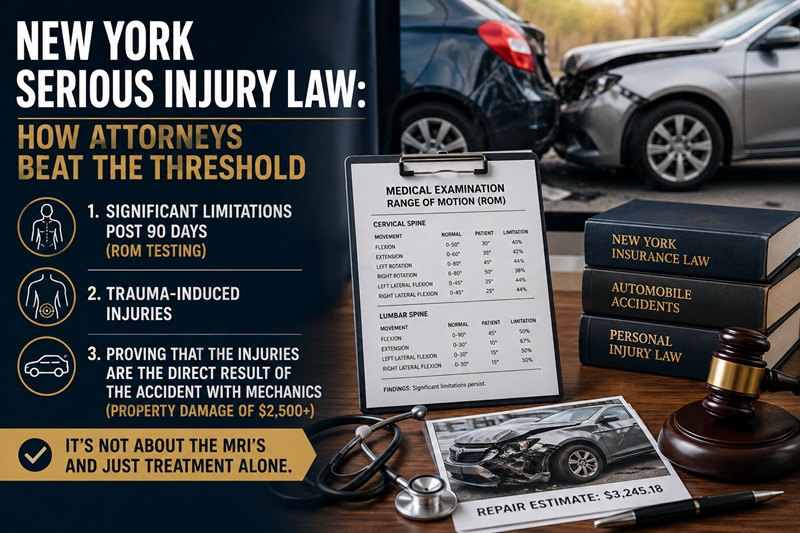
Beating the New York State Serious Injury Threshold Laws - New York Insurance Law § 5104
One of the most misunderstood parts of New York automobile accident law is the “serious injury threshold.” Many people assume that if an MRI shows a herniated disc, bulging disc, torn shoulder, or some other injury, the case automatically qualifies as a serious injury case. That is not how it works. It is also not enough simply to show that the injured person went to physical therapy for several months, received injections, saw multiple doctors, or accumulated a large stack of medical records. Those things may support the case, but they do not automatically prove that the person suffered a serious injury under New York law.
Under New York Insurance Law, a person injured in a motor vehicle accident generally must prove that he or she suffered a legally defined “serious injury” before recovering money for pain and suffering. There are several ways to qualify, including fractures, significant disfigurement, permanent loss of use, permanent consequential limitation, and significant limitation of a body function or system. For many neck, back, shoulder, and knee cases, the most important category is significant limitation of use.
The key word is “limitation.” The question is not simply whether an MRI shows something abnormal. The real question is whether the accident caused an injury that actually limits how the person’s body functions. This is why attorneys need to build these cases around objective medical findings, the history of the accident, the mechanics of the collision, and a clear explanation connecting everything together.
Significant Limitation and Range-of-Motion Testing
One of the strongest ways to prove a significant limitation is through objective range-of-motion testing. For example, saying that a patient has neck pain is very different from documenting that the patient can only move his or her neck 30 degrees when the normal range is 50 degrees. The first statement describes pain. The second provides measurable evidence that the person has lost part of the normal function of that body part.
This is why range-of-motion testing should be taken seriously. The physician should measure the injured body part, compare the result to the normal range, and explain the percentage or degree of limitation. If the limitation continues months after the accident, that evidence becomes even stronger because it shows that the condition did not simply disappear after the initial soreness and inflammation went away.
Testing after the first several months can therefore be especially useful. This does not mean that New York law has a magical rule where an injury suddenly becomes serious on day 91. It does not. The importance of later testing is that it helps establish duration. A limitation found three days after a crash might be temporary. A significant limitation that is still objectively measured three or four months later is much harder for the defense to dismiss as ordinary soreness.
A good medical record should tell a clear story from the beginning. The patient was involved in an accident, was examined shortly afterward, had objective findings, received treatment, and continued to have measurable restrictions during later examinations. That is much more persuasive than simply producing hundreds of pages of repetitive physical therapy notes saying that the patient continues to complain of pain.
The Injury Must Be Connected to the Accident
The second major issue is causation. Even if the patient has an abnormal MRI and restricted range of motion, the insurance company may argue that the condition was not caused by the accident. The defense may claim that the injury was caused by normal aging, arthritis, degeneration, a prior accident, an old sports injury, or some other condition that existed before the crash.
This is where the treating doctor has to do more than simply write, “The injuries are causally related to the accident.” The doctor should explain why they are related. If the patient had no neck complaints before the accident and suddenly developed neck pain and restricted movement immediately afterward, that history is important. If the MRI shows findings that the physician believes are consistent with trauma, the physician should explain that. If the patient had a prior condition, the doctor should explain whether the accident caused a new injury or made an older condition significantly worse.
Attorneys should also investigate prior accidents and medical treatment early instead of waiting for the defense to discover them. If the client was involved in another accident five years earlier, pretending it never happened will only create problems later. The better approach is to obtain the records, understand what was injured before, and have the treating physician explain the difference between the old condition and the injuries caused by the current accident.
A strong serious injury case should therefore show that the accident was not merely something that happened around the same time as the medical complaints. The evidence should demonstrate that the accident actually caused the condition being claimed.
Trauma-Induced Injuries Matter
This is especially important when dealing with spinal injuries. Insurance companies frequently argue that disc herniations and bulges are degenerative and could have existed before the accident. Sometimes that argument is valid, and sometimes it is not. What matters is whether the medical evidence can distinguish between ordinary degeneration and a condition that was caused or aggravated by trauma.
The doctor should look at the patient's age, prior symptoms, prior medical history, MRI findings, physical examination, timing of the symptoms, and the nature of the accident. If the patient had no symptoms before the crash and immediately developed significant symptoms afterward, that is part of the causation analysis. If the doctor believes the collision aggravated a preexisting condition, that should also be clearly explained instead of simply ignoring the prior condition.
This is where good medical reports become extremely important. A report should not merely repeat the MRI findings. It should explain what those findings mean, whether they are consistent with trauma, what functional limitations they produced, and why the physician believes the accident caused those limitations.
The Mechanics of the Accident Can Help Prove Causation
The third part of the case is something many attorneys do not develop enough: the actual mechanics of the collision. If the insurance company is going to argue that the impact was too minor to cause the claimed injuries, then the attorney needs evidence showing what actually happened during the crash.
That means obtaining photographs of both vehicles, repair estimates, final repair bills, towing records, police reports, information about where the vehicles were struck, and any evidence of structural damage. In a more serious case, an accident reconstruction expert or biomechanical expert may also be useful in explaining how the force of the collision moved the person's body and whether that movement was capable of causing the claimed injuries.
For example, consider a rear-end collision where the defense describes the accident as a minor “tap.” If photographs show crushed body panels, broken components, substantial repairs, towing from the scene, and several thousand dollars in documented damage, the attorney now has evidence that can be used to challenge the defense's description of the collision.
I often look closely at cases involving approximately $2,500 or more in documented property damage because substantial repair costs can help demonstrate that the accident involved meaningful force. However, this needs to be understood correctly. New York law does not say that $2,500 in vehicle damage automatically proves a serious injury. There is no legal $2,500 property-damage threshold.
Repair cost is simply one piece of evidence. Modern vehicles contain cameras, sensors, lights, electronics, and expensive body parts, so even relatively minor damage can sometimes cost thousands of dollars to repair. That is why attorneys should look at the entire picture, including the photographs, location of the damage, type of damage, repair records, direction of impact, and movement of the occupant inside the vehicle.
When those facts match the medical evidence, the case becomes much stronger. If the vehicle was hit hard from behind, the occupant was thrown forward and backward, the patient immediately complained of neck and back pain, doctors documented restricted movement, and later testing continued to show significant limitations, there is now a logical connection between the accident and the injuries.
An MRI Is Evidence, Not the Entire Case
This is probably the most important lesson for both attorneys and injured clients. An MRI is useful because it shows what is happening inside the body, but an MRI by itself does not tell the entire story. A person can have a disc herniation without having a legally significant limitation. Another person may have an MRI finding combined with substantial loss of motion, weakness, pain, difficulty working, and continuing functional problems.
The second case is much easier to explain because the attorney can show how the medical condition actually affects the person.
The same applies to treatment. Going to physical therapy three times a week for six months does not automatically satisfy the serious injury threshold. Treatment supports the case, but the important question is what the medical evidence actually proves. Did the patient have objective limitations? Were those limitations measured? Did they continue over time? Did the doctor explain the connection between the accident and the injuries? Were prior conditions addressed? Does the accident itself make sense as the cause of the injury?
Those questions are much more important than simply counting how many physical therapy visits the client attended.
Build the Serious Injury Case From the Beginning
Attorneys should not wait until the insurance company files a motion for summary judgment to start thinking about the serious injury threshold. The case should be developed with the threshold in mind from the beginning.
Obtain the vehicle photographs and property damage records immediately. Find out whether the client had prior accidents or injuries. Make sure the treating physicians have an accurate medical history. Obtain objective range-of-motion measurements and meaningful follow-up examinations. If the defense is likely to argue degeneration, make sure the treating physician addresses it. If the collision involved substantial damage, preserve the evidence showing the mechanics of the accident.
The goal is to create one clear and believable story. The accident created trauma. The trauma caused or aggravated a medical condition. The medical condition resulted in an objectively measurable limitation. That limitation continued long enough and was significant enough to qualify under New York's serious injury law.
In simple terms, a strong threshold case should connect the accident, the injury, and the limitation.
An MRI shows anatomy. Treatment shows that the patient received medical care. Property damage helps explain the collision. Range-of-motion testing demonstrates loss of function. Medical opinions establish causation. When all of those pieces support each other, the attorney has a much stronger case against a serious injury threshold motion.
Winning the threshold fight is not about having the biggest MRI report or the thickest medical file. It is about proving, with objective evidence, that the accident caused a real injury that significantly affected how the person's body functions.
Comments
Leave a comment
No account is required. Your email address is required for payment/moderation records but is never displayed publicly. Comments are not eligible for approval until the $5.00 Stripe payment is verified, and payment does not guarantee approval.