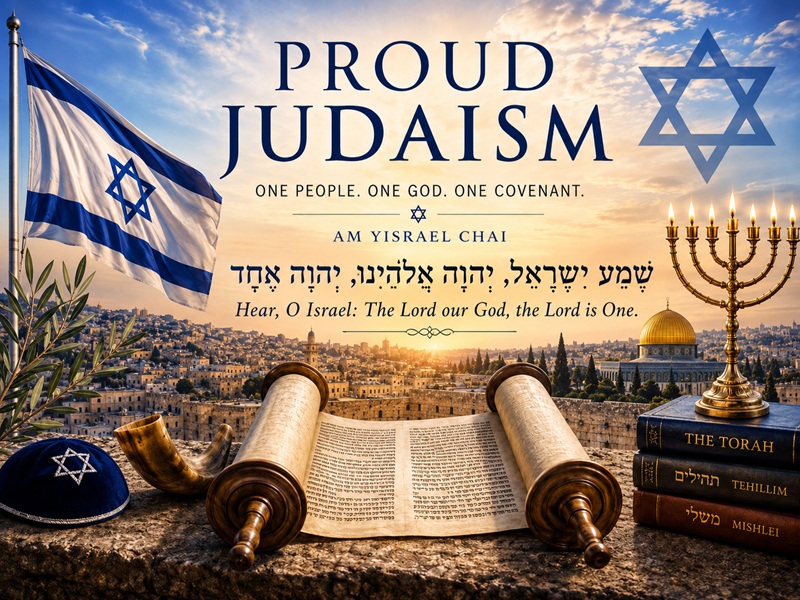
Problem with Judaism
Before getting into this, I want to make an important distinction. This is not an attack on Jewish people, Jewish ancestry, Jewish culture, or the State of Israel. I happen to be Jewish. My criticism is directed specifically at Rabbinic Judaism as a religious system and at the question of how much modern Jewish religious practice comes directly from the Torah compared with how much developed later through rabbinic interpretation, custom, legal rulings, and tradition. Making Judaism ridiculously overbearing. I believe that distinction matters because criticizing a religious doctrine is very different from attacking a people. When you reach a point where you have to study Jewish Law 8 hours a day for the rest of your life, just to understand some of it, it turns into an institution. Not a religion based on faith.
My concern is actually fairly simple. The Torah presents a covenant between the God of Israel and the people of Israel. Over many centuries, however, that covenant became surrounded by an enormous body of interpretation and procedure. Rabbis became interpreters of the law, then later generations interpreted the earlier rabbis, and eventually the average person could be faced with a religious system far more complicated than the written commandments themselves. Teachers and scholars certainly have value, but there should always be a clear distinction between what God commanded and what human religious authorities later developed.
What Is Judaism, and Who Is Really a Jew?
One of the first questions worth asking is what the word Jew originally meant. Long before the modern religious term Judaism existed, the Bible speaks repeatedly about Israel and the Children of Israel. Jacob was given the name Israel, and his descendants became the tribes of Israel. Judah was only one of those tribes. Benjamin was another. Levi was another. Ephraim, Manasseh, Reuben, Simeon, Issachar, Zebulun, Dan, Naphtali, Gad, and Asher were all part of the same national and covenantal identity.
Moses himself was not from the tribe of Judah. Moses was a Levite. Aaron was also a Levite, and the biblical priesthood came from Levi. King David came from Judah, while King Saul came from Benjamin. The prophets addressed both Israel and Judah at different points in biblical history. The identity presented throughout the Torah was therefore much broader than the later word Jew. It was the identity of Israel.
Historically, the word Jew, from Yehudi, became associated with Judah and later Judea. After the kingdom divided, the southern Kingdom of Judah was centered primarily around Judah and Benjamin and also included Levites and people from other Israelite tribes. The northern Kingdom of Israel was later conquered by Assyria, while Judah survived longer before the Babylonian exile. Over time, particularly after the exile, Jew became a much broader designation for the surviving people associated with Judah and Judea and was no longer limited to someone who could prove literal descent from the tribe of Judah.
So I am not arguing that modern Jews are somehow required to prove that they descend exclusively from Judah or Benjamin. History is obviously much more complicated than that. My point is that Israelite is the older and, in my view, more unifying biblical identity. Judah was a tribe. Israel was the nation. Moses addressed Israel, the covenant was given to Israel, the commandments were given to Israel, and God repeatedly identifies Himself as the God of Abraham, Isaac, and Jacob.
Perhaps there is something valuable in rediscovering that older identity. Instead of allowing later denominational labels and tribal terminology to define everything, there is a certain power in returning to the name that encompasses the entire biblical people: Israel. That does not erase Jewish history or tradition. It simply remembers what came first.
When Religious Interpretation Becomes Religious Bureaucracy
My second problem with Rabbinic Judaism is the enormous accumulation of religious procedures, regulations, customs, observances, restrictions, blessings, fasts, safeguards, and interpretations that developed around the Torah. To be fair, the Torah itself contains many commandments. Nobody who has seriously read Exodus, Leviticus, Numbers, and Deuteronomy can reasonably claim that biblical law is simplistic. There are commandments dealing with morality, courts, agriculture, festivals, food, ritual purity, the priesthood, sacrifice, property, marriage, Sabbath observance, and many other areas of life.
But there is still an important distinction between a commandment that appears in the Torah and a later religious rule designed to protect, interpret, expand, or regulate that commandment. Deuteronomy 4:2 warns Israel not to add to what God commanded or subtract from it. That does not mean legal interpretation is impossible. Courts obviously have to interpret laws in actual disputes. It does, however, mean we should be cautious about allowing later regulations to become practically indistinguishable from commandments attributed directly to God.
One of the foundational principles of rabbinic tradition appears in Pirkei Avot 1:1, which instructs the sages to "make a fence around the Torah." The idea is understandable. If the Torah prohibits crossing a certain line, rabbinic authorities may create additional precautions so that people do not accidentally cross it. The problem is that once this process continues for centuries, the fence can become enormous. A safeguard produces another rule, that rule produces another legal question, later authorities interpret the earlier ruling, and eventually the religious structure surrounding the commandment can become far more complicated than the commandment itself.
The Sabbath is one of the clearest examples. The Torah plainly commands Israel to remember and keep the Sabbath and prohibits work on that day. Rabbinic literature later identifies thirty-nine major categories of prohibited labor and develops extensive legal discussions explaining how those categories apply. Over time, detailed rules emerged concerning carrying, cooking, writing, sorting, building, tearing, tying, transportation, electricity, appliances, and countless modern activities. Some of these rulings may be thoughtful attempts to apply ancient commandments to new technology, but the practical result is that Sabbath observance can become a highly technical legal system that ordinary people could never reconstruct merely by reading the Torah.
The concept of an eruv illustrates the same issue. Through rabbinic legal categories, boundaries can be established that affect whether carrying certain objects on the Sabbath is permitted within a defined area. The average person reading the written Torah would never independently arrive at the elaborate jurisprudence surrounding an eruv. It exists because generations of scholars developed a legal framework around the original commandment. Again, the issue is not whether rabbis are permitted to reason about the law. The issue is whether the conclusions of that reasoning should eventually be treated with nearly the same religious weight as the commandment itself.
Ritual hand washing provides another example. Rabbinic Judaism contains detailed requirements governing washing before eating bread, including the water, the vessel, the manner of pouring, and the blessing associated with it. Washing one's hands is obviously a good practice, and nobody needs a theological argument to defend basic hygiene. But the religious question is different. If a practice originated as a rabbinic enactment, then it should be clearly identified as a rabbinic enactment rather than being presented as though Moses brought that precise procedure down from Mount Sinai.
Commanded Festivals and Later Observances
The same distinction should be made when discussing holidays. The Torah establishes a specific sacred calendar. It includes the weekly Sabbath and annual observances such as Passover and the Feast of Unleavened Bread, Shavuot, Yom Teruah, the Day of Atonement, and Sukkot. These observances are explicitly connected to commandments within the Torah.
Other Jewish holidays and commemorations developed in later historical periods. Purim is based on the events described in the Book of Esther. Hanukkah commemorates the Maccabean period, which occurred many centuries after Moses. Additional fasts, memorial days, customs, and community celebrations developed during later Jewish history. There is nothing inherently wrong with commemorating historical events. Nations, families, and religious communities do that all the time. The important point is simply that a historical commemoration and a festival explicitly commanded in the Torah are not automatically the same category of observance.
That distinction should not be controversial. Something can be meaningful, ancient, and valuable without being a commandment given through Moses. A person should be able to say, "This is a Jewish tradition that developed later," without feeling obligated to pretend that it appears in the Torah when it does not.
The Talmud and the Expansion of Religious Law
This brings me to what is probably my largest disagreement with Rabbinic Judaism: the authority given to the Talmud. The Talmud is not the Five Books of Moses. It is an enormous compilation of rabbinic debate, legal reasoning, interpretation, commentary, stories, hypothetical cases, majority opinions, minority opinions, and discussions surrounding the Mishnah and Jewish law. It is intellectually fascinating and historically important, and there is nothing wrong with studying it. In fact, anyone seriously interested in Jewish history should probably understand what it contains and how deeply it influenced later Judaism.
My problem begins when rabbinic discussion becomes so authoritative that it functions almost as an additional layer of revelation. There is a major difference between saying that ancient rabbis debated how to understand the Torah and saying that those debates should govern religious life with authority approaching that of the Torah itself.
The instruction in Pirkei Avot to create a fence around the Torah captures this tension perfectly. The original purpose is protective, but the accumulated result can become overwhelming. Once religious authorities create safeguards around commandments, later authorities must determine how those safeguards operate. Then new circumstances require new rulings. The rulings themselves become precedents. Eventually a tremendous secondary legal system develops, and a person may spend more time determining what rabbis prohibited around a commandment than reading the commandment itself.
Eruvin 21b contains particularly strong language concerning the importance of the words of the sages. The passage emphasizes extreme caution regarding rabbinic rulings and uses severe language about disregarding them. These statements have their own Talmudic and rhetorical context and should not be ripped out of that context as though ordinary Jewish courts were simply executing people for every violation of a rabbinic custom. Nevertheless, the passage demonstrates how seriously rabbinic authority came to be treated.
That raises a legitimate theological question. If a rule was created by rabbis as a safeguard, should violating that safeguard be treated as more serious than the underlying commandment given in the Torah? At what point does protecting the Torah begin to compete with the Torah? A fence is supposed to protect something. It should never become more important than the thing it surrounds.
The discussion of Hanukkah in Shabbat 23a creates another interesting example. The traditional blessing over Hanukkah lights speaks of God having commanded the lighting of the lamp, yet Hanukkah occurred long after the Torah was given. The Talmud itself addresses the question of where such a command originated and connects the practice to biblical passages concerning obedience to legitimate religious and judicial authority.
I understand the reasoning. The argument is that if God commanded Israel to obey legitimate authorities, then a valid enactment issued by those authorities ultimately derives its authority from God. But I still believe a distinction should remain between God explicitly commanding something in the Torah and religious authorities creating a later observance under authority they believe the Torah granted them. Those are not identical claims, and religious honesty requires acknowledging the difference.
The Strongest Rabbinic Counterargument
To be fair to Rabbinic Judaism, there is a serious biblical argument supporting judicial interpretation. Deuteronomy 17:8-11 instructs Israelites to bring difficult legal matters before the priests and judges and tells the people to follow their decisions. Rabbinic Judaism therefore argues that authoritative interpretation is not an invention added to the Torah but part of the legal structure established by the Torah itself.
That argument deserves to be taken seriously. A functioning legal system obviously cannot operate without judges interpreting laws. Written commandments do not automatically answer every factual question, dispute, technological development, or unusual circumstance that may arise. Even modern legal systems contain statutes, judicial decisions, administrative interpretations, and precedents because written law always requires application.
My disagreement is about the scope of that authority. There is a difference between resolving a dispute about how an existing commandment applies and constructing an expanding religious legal system that regulates virtually every detail of everyday life. There is a difference between interpretation and legislation. There is a difference between explaining a commandment and adding layers of religious obligation around it. Those boundaries deserve constant examination.
Returning to the Torah
My position is not that every rabbi is wrong, that every tradition is worthless, or that two thousand years of Jewish scholarship should be thrown into the garbage. Quite the opposite. Rashi, Maimonides, the Mishnah, the Talmud, and countless Jewish thinkers are part of an enormous intellectual tradition that deserves to be studied. Rabbis can offer wisdom. Tradition can preserve history. Commentary can illuminate difficult passages. Human teachers are valuable.
But human teachers are still human. A rabbi can be brilliant and still be wrong. A majority of scholars can reach a conclusion without turning that conclusion into the literal words spoken by God at Sinai. A tradition can exist for fifteen hundred years and still remain a tradition rather than a Torah commandment. Respecting scholars does not require confusing scholars with the Lawgiver.
I would rather begin with the Torah itself and work outward. What did God actually command Israel? What did Moses actually write? What did the prophets actually say? After establishing that foundation, rabbinic commentary can be studied as commentary. Historical customs can be recognized as historical customs. Later holidays can be appreciated as later holidays. Legal interpretations can be evaluated as legal interpretations.
The distinction is not disrespectful. It is intellectually honest.
Perhaps We Need to Remember Israel
Maybe the answer is not abandoning Jewish history or pretending that centuries of tradition never existed. Maybe the answer is recovering the foundation underneath all of it. Before Orthodox Judaism, Conservative Judaism, Reform Judaism, Hasidic Judaism, Ashkenazi and Sephardi traditions, medieval legal codes, and generations of rabbinic commentary, there was Israel.
Moses was a Levite. David was from Judah. Saul was from Benjamin. The prophets addressed Israel and Judah. The priesthood came through Levi. Different tribes had different histories and responsibilities, but they belonged to one larger covenantal people. That larger identity was Israel.
For me, that is a more powerful starting point. Read the Torah. Study the prophets. Learn Jewish history. Read the rabbis and challenge them when necessary. Respect tradition without worshiping tradition. Respect teachers without treating every later ruling as though it came directly from Mount Sinai. Most importantly, distinguish between what God commanded and what human beings later decided was necessary to protect or interpret those commandments.
Religion becomes dangerous when questioning human authority is treated as questioning God Himself. No rabbi, priest, pastor, scholar, denomination, or religious institution should be above examination. If a rule is biblical, show it in the Bible. If it is rabbinic, call it rabbinic. If it is tradition, call it tradition. If it is history, call it history. There should be no fear in making those distinctions.
Perhaps the simplest way forward is also the oldest: remember the God of Abraham, Isaac, and Jacob, remember the Torah given through Moses, and remember the people who stood together under one name long before thousands of pages of later religious law were written.
Israel.
Editorial Note: This article is a critique of religious doctrine, rabbinic authority, and the development of Jewish religious law. It is not intended as hostility toward Jewish people, Jewish ethnicity, or Jewish culture.
Comments
Leave a comment
No account is required. Your email address is required for payment/moderation records but is never displayed publicly. Comments are not eligible for approval until the $5.00 Stripe payment is verified, and payment does not guarantee approval.