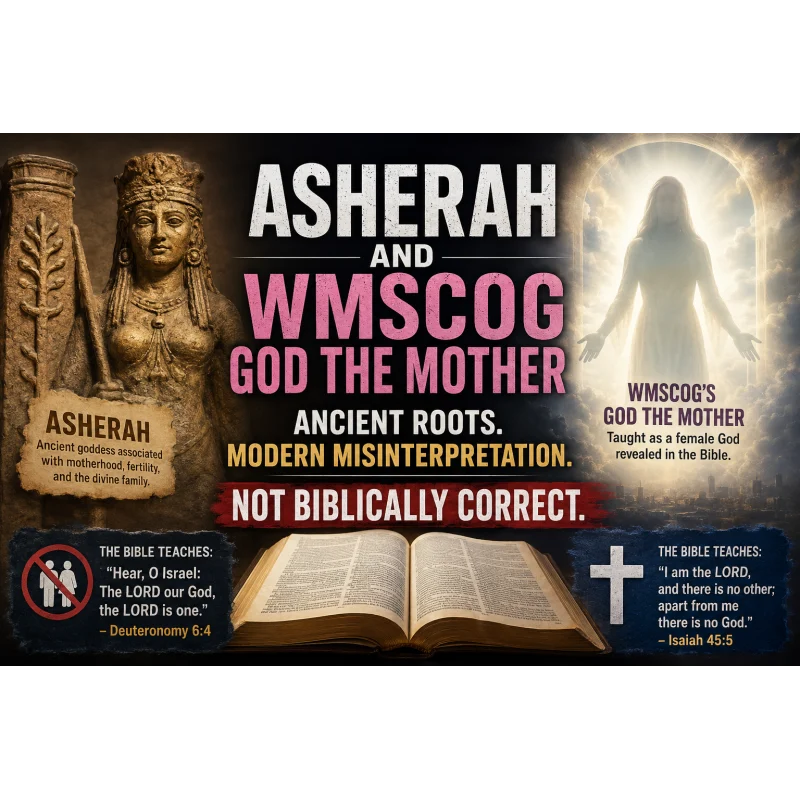
Asherah and WMSCOG’s “God the Mother”: An Ancient Idea That Is Not Biblically Correct
The World Mission Society Church of God teaches that there is both God the Father and God the Mother. According to WMSCOG, these two divine beings make up the heavenly family and are both necessary for eternal life. The church teaches that the Bible reveals God the Mother through passages such as Genesis 1:26-27, the Hebrew word Elohim, Galatians 4:26, and Revelation 22:17. At first glance, some of these verses may sound convincing when they are presented by themselves. The problem is that when the passages are read in their full context, they do not teach the existence of a literal female God. WMSCOG builds its doctrine by taking symbolic language, grammatical forms, and biblical imagery and turning them into a divine person that the Bible itself never clearly introduces.
This becomes even more interesting when we look at ancient history. Long before WMSCOG existed, people in the ancient Near East already believed in female divine figures who stood beside male gods. One of the most important of these goddesses was Asherah. In ancient Canaanite religion, Asherah was associated with motherhood, fertility, life, and the divine family. She was connected with El, the chief god of the Canaanite religious system, and was often viewed as his consort. In simple terms, ancient Canaanite religion already had the idea of a divine father and a divine mother.
The important point is not that WMSCOG literally worships Asherah. There is no solid historical evidence that the founders of WMSCOG deliberately copied ancient Asherah worship or secretly tried to restore a Canaanite goddess. Making that accusation would go beyond the evidence. However, the theological similarity is difficult to ignore. In both systems, a female divine figure is placed beside a male divine figure, and that female figure is connected with motherhood, life, and a heavenly family. The names and explanations are different, but the basic religious structure is very similar.
This comparison becomes even more important because the Bible itself shows that some ancient Israelites tried to combine the worship of Yahweh with Asherah. Archaeological discoveries have uncovered inscriptions that appear to associate Yahweh with Asherah. Scholars debate the exact meaning of some of these inscriptions, including whether Asherah refers directly to the goddess or sometimes to a sacred object connected with her worship. Even with that debate, the larger historical picture is clear. Some people within ancient Israel were mixing the worship of Yahweh with religious beliefs involving Asherah.
The Bible did not treat this as a forgotten truth about God. It treated it as corruption. Deuteronomy 16:21 commands Israel not to place an Asherah pole beside the altar of the LORD. Judges describes Israel falling into the worship of the Baals and Asherahs. First Kings describes the religious corruption associated with Baal and Asherah during the reign of Ahab and Jezebel. Second Kings describes an Asherah image being placed in the Temple itself, and during the reforms of King Josiah, the Asherah was removed and destroyed. The biblical message is therefore very clear. When a female divine figure became associated with the worship of Yahweh, the writers of Scripture did not celebrate it as proof of a heavenly Mother. They condemned it and demanded that it be removed.
“Do not set up any wooden Asherah pole beside the altar you build to the LORD your God.” — Deuteronomy 16:21
That command is especially important when discussing WMSCOG. God did not tell Israel that Asherah represented a forgotten female side of Himself. He did not tell Israel that they needed both a heavenly Father and a heavenly Mother. Instead, Israel was commanded not to place Asherah beside the altar of the LORD. The biblical response to combining a female divine figure with the worship of Yahweh was rejection, not acceptance.
That history creates a serious problem for WMSCOG. If God the Mother were truly an essential part of God's identity, and if believers needed to recognize her in order to receive eternal life, then the Old Testament would be an extremely strange place for God to repeatedly condemn the placement of a female divine figure beside Himself. Instead of teaching Israel that they had discovered the feminine side of God, the Bible repeatedly commands them to worship Yahweh alone.
“Hear, O Israel: The LORD our God, the LORD is one.” — Deuteronomy 6:4
“I am the LORD, and there is no other; apart from me there is no God.” — Isaiah 45:5
The biblical direction is consistently toward the exclusive worship of the God of Israel, not toward the discovery of a second female deity. This does not mean that the Bible never uses feminine imagery to describe God's love or protection. It sometimes does. However, comparing God to a mother is completely different from teaching that there is a separate female God whom believers must recognize for salvation.
Genesis Does Not Teach God the Mother
WMSCOG attempts to support its doctrine by using several Bible passages. One of the most common is Genesis 1:26, where God says that humanity will be made in His image and likeness. The following verse explains that humanity was created male and female. WMSCOG argues that because both men and women were created in God's image, there must be both a male image of God and a female image of God. According to this interpretation, the male image is God the Father and the female image is God the Mother.
“Then God said, ‘Let us make mankind in our image, in our likeness.’” — Genesis 1:26
“So God created mankind in his own image, in the image of God he created them; male and female he created them.” — Genesis 1:27
The problem is that Genesis never says that man was created in the image of a male God while woman was created in the image of a female God. The passage says that humanity, male and female, was created in God's image. Both sexes reflect the image of the same Creator. WMSCOG inserts an additional idea into the passage and then treats that idea as though Genesis itself had stated it.
The existence of men and women does not prove that heaven contains one male deity and one female deity. Human beings can reflect qualities of God without God's nature being divided according to human biological sex. Men and women can both reflect God's intelligence, morality, creativity, ability to love, and spiritual nature. Nothing in the passage requires the existence of God the Mother.
The Bible sometimes uses maternal comparisons for God, but those comparisons do not create another deity. Isaiah compares God's comfort to the comfort of a mother. Jesus compares His desire to gather Jerusalem to a hen gathering chicks beneath her wings. These are metaphors. Nobody concludes that Jesus is literally a female bird because He used the image of a hen. In the same way, maternal imagery about God does not prove the existence of a separate female divine being.
Elohim Does Not Mean Father and Mother
Another major WMSCOG argument involves the Hebrew word Elohim. Because the word has a plural grammatical form, WMSCOG argues that it reveals multiple divine beings, specifically God the Father and God the Mother. This can sound convincing to someone who does not know Hebrew, but the argument does not work the way WMSCOG presents it.
When Elohim refers to the God of Israel, it normally functions grammatically as singular. Genesis 1:1 provides one of the clearest examples.
“In the beginning God created the heavens and the earth.” — Genesis 1:1
The Hebrew verb translated as “created” is singular. The passage does not say that multiple gods created the heavens and the earth. Even though Elohim has a plural-looking form, the grammar treats the God of Israel as the singular subject of the sentence.
More importantly, even if someone believes that the Bible contains complexity within the nature of God, nothing about the word Elohim identifies one divine person as male and another as female. The word does not mean “Father and Mother.” WMSCOG takes a feature of Hebrew grammar and adds an entire Father-and-Mother theology that is not contained in the word itself.
Galatians 4:26 Is an Allegory, Not a Female God
Perhaps the most important passage used by WMSCOG is Galatians 4:26. Paul refers to the Jerusalem above as “our mother,” and WMSCOG presents this statement as direct proof that a literal God the Mother exists in heaven.
“But the Jerusalem that is above is free, and she is our mother.” — Galatians 4:26
The problem becomes obvious when the surrounding passage is read instead of isolating one sentence. Paul is discussing Abraham's family, particularly Hagar and Sarah, and he explains that he is using these women symbolically. Hagar represents one situation, while Sarah represents another. Paul connects Hagar with slavery and the present Jerusalem, while Sarah represents freedom and corresponds to the Jerusalem above.
“These things are being taken figuratively: The women represent two covenants.” — Galatians 4:24
Paul tells the reader directly that he is using figurative or allegorical language. This makes the WMSCOG interpretation extremely difficult to defend. If Paul says that the women represent covenants, it makes little sense to take the symbolic “Jerusalem above” from the same passage and suddenly turn it into a literal female deity.
The purpose of Paul's argument becomes even clearer when he compares Christians with Isaac.
“Now you, brothers and sisters, like Isaac, are children of promise.” — Galatians 4:28
Paul's subject is promise, freedom, slavery, covenant, and spiritual inheritance. He is not introducing another member of the Godhead. WMSCOG takes one phrase from the middle of an allegory and changes “Jerusalem above is our mother” into “there is a literal female God whom Christians must recognize for salvation.” Paul himself never makes that claim.
The Bride in Revelation Is Not God the Mother
WMSCOG also relies heavily on Revelation 22:17, which says that the Spirit and the Bride invite people to come and receive the water of life. WMSCOG teaches that the Spirit represents God the Father and that the Bride therefore represents God the Mother.
“The Spirit and the bride say, ‘Come!’” — Revelation 22:17
However, Revelation itself tells the reader what the Bride represents. This does not require speculation. In the previous chapter, an angel tells John that he will show him the Bride, the wife of the Lamb.
“Come, I will show you the bride, the wife of the Lamb.” — Revelation 21:9
John then describes what the angel showed him.
“And he carried me away in the Spirit to a mountain great and high, and showed me the Holy City, Jerusalem, coming down out of heaven from God.” — Revelation 21:10
The Bride is identified with the New Jerusalem. Revelation had already introduced this imagery earlier in the chapter.
“I saw the Holy City, the new Jerusalem, coming down out of heaven from God, prepared as a bride beautifully dressed for her husband.” — Revelation 21:2
The language is obviously symbolic. A literal city does not put on a wedding dress and marry Jesus. The New Jerusalem represents the final dwelling of God with His redeemed people, and bridal imagery is used throughout the New Testament to describe the relationship between Christ and His people.
Paul uses similar imagery when discussing Christ and the Church in Ephesians 5. The Church is pictured in a relationship with Christ comparable to that of a bride with her husband. Revelation continues this same biblical imagery. There is no need to invent a separate female God in order to explain the Bride.
The WMSCOG interpretation also creates another problem because Revelation calls the Bride “the wife of the Lamb.” The Lamb is Jesus Christ. If the Bride is literally God the Mother, then WMSCOG must somehow explain why this female divine being is described as the wife of Christ. That complicated problem disappears when Revelation is read according to its own symbolic language.
The Heavenly Family Argument Is Human Reasoning
WMSCOG frequently argues that every earthly family contains a father, a mother, and children. Since believers are called children of God and God is called Father, WMSCOG concludes that there must also be a divine Mother. The argument is simple: if there are heavenly children and a heavenly Father, there must also be a heavenly Mother.
The problem is that the Bible never makes this argument. It is based on human biology rather than biblical teaching. God is the Creator. He does not require a wife or biological reproduction in order to create spiritual children. Calling believers God's children describes a spiritual relationship involving love, inheritance, belonging, and adoption. It does not mean that believers were spiritually conceived through heavenly biological reproduction.
Jesus also warns against simply assuming that earthly marriage relationships continue in the same manner in heaven.
“At the resurrection people will neither marry nor be given in marriage.” — Matthew 22:30
Heaven is therefore not simply a larger version of an earthly household. WMSCOG begins with the human family and then forces God's nature to match that structure. The Bible does not instruct us to define God according to human reproductive biology.
Jesus Never Taught God the Mother
Perhaps the strongest argument against the WMSCOG doctrine is remarkably simple. Jesus never taught His followers that they needed to recognize or worship God the Mother. If God the Mother were necessary for salvation, Jesus had countless opportunities to reveal her. Instead, Jesus constantly speaks about the Father.
When His disciples asked Him how to pray, Jesus gave them clear instructions.
“Our Father in heaven, hallowed be your name.” — Matthew 6:9
Jesus did not teach His disciples to say, “Our Father and Mother in heaven.” He repeatedly spoke about “my Father,” “your Father,” and “our Father.” There is no corresponding teaching in which Jesus introduces another divine person and tells the disciples that she is their Heavenly Mother.
This is especially important because WMSCOG does not treat God the Mother as an optional theological idea. The church presents recognition of Heavenly Mother as a central spiritual truth connected with eternal life. If that doctrine were truly necessary for salvation, its complete absence from the direct teachings of Jesus would be extremely difficult to explain.
The Apostles Did Not Preach God the Mother
The same problem continues throughout the New Testament. Peter does not preach God the Mother at Pentecost. Paul does not travel throughout the Roman Empire establishing churches dedicated to a heavenly Mother. John does not plainly tell Christians that they must recognize a female God in order to receive eternal life. The apostles constantly speak about God the Father, Jesus Christ, the Holy Spirit, repentance, faith, grace, resurrection, judgment, and salvation, but they do not preach WMSCOG's God the Mother doctrine.
Instead, the New Testament places Jesus Christ at the center of salvation.
“I am the way and the truth and the life. No one comes to the Father except through me.” — John 14:6
“Salvation is found in no one else.” — Acts 4:12
“For God so loved the world that he gave his one and only Son, that whoever believes in him shall not perish but have eternal life.” — John 3:16
These passages describe salvation without mentioning God the Mother. The Gospel message consistently directs people toward Christ. The apostles never add a requirement that believers must identify a female divine being represented by Jerusalem or Revelation's Bride.
Asherah Makes the WMSCOG Teaching Even More Troubling
The historical connection with Asherah does not mean that WMSCOG literally worships Asherah or that its founders intentionally revived Canaanite religion. There is no evidence strong enough to make that accusation. However, Asherah demonstrates that the idea of adding a female divine figure beside the God worshiped by Israel is not new.
Ancient Canaanite religion already contained the idea of a divine father and divine mother. Some people in ancient Israel apparently attempted to mix the worship of Yahweh with Asherah-related religion. Instead of presenting this as a hidden truth that Israel had finally discovered, the Bible condemned the practice and repeatedly called Israel back to exclusive worship of Yahweh.
This history creates a powerful contrast with WMSCOG. WMSCOG argues that humanity has forgotten God the Mother and that this female divine figure must now be recognized again. Yet when ancient Israel associated a female divine figure with the worship of Yahweh, Scripture did not describe it as restoration. Scripture described it as religious corruption.
“The LORD is God; besides him there is no other.” — Deuteronomy 4:35
“I am the first and I am the last; apart from me there is no God.” — Isaiah 44:6
“I am the LORD, and there is no other.” — Isaiah 45:5
The biblical message is not that people must search for a forgotten female partner of God. The biblical message repeatedly calls people back to the God of Israel.
Why WMSCOG’s Interpretation Is Not Biblically Correct
When WMSCOG's major proof texts are examined together, a clear pattern appears. Genesis says humanity was created male and female in God's image, and WMSCOG turns that into two divine parents. The Hebrew word Elohim has a plural grammatical form, and WMSCOG turns that into Father and Mother even though the word functions as singular when referring to the God of Israel. Galatians uses Jerusalem as part of an explicitly symbolic discussion involving Sarah and Hagar, and WMSCOG turns that symbolism into a literal female deity. Revelation describes the New Jerusalem as a Bride, and WMSCOG turns the symbolic Bride into God the Mother.
In each case, the doctrine is not plainly stated in the passage. It must first be inserted into the passage and then used to interpret the passage. This creates circular reasoning. WMSCOG begins with the belief that God the Mother exists, interprets biblical symbols through that belief, and then presents those interpretations as proof that God the Mother exists.
A doctrine this important should not require that kind of method. If belief in God the Mother were necessary for salvation, we would reasonably expect Jesus and the apostles to teach it clearly and repeatedly. Instead, the doctrine depends primarily on interpreting symbolic passages in a way that the original context does not require.
The WMSCOG doctrine of God the Mother is not biblically correct when the relevant passages are read in their full context. The Bible never clearly introduces a separate female deity whom Christians must recognize alongside God the Father. Jesus never teaches His disciples to worship God the Mother. The apostles never preach God the Mother as part of the Gospel. Salvation is repeatedly centered on God through Jesus Christ, without an additional requirement to identify a heavenly female deity.
Genesis does not teach two divine parents. The word Elohim does not mean God the Father and God the Mother. Galatians 4:26 occurs inside an allegory that Paul himself explains. Revelation identifies the Bride with the New Jerusalem and uses the same symbolic marriage language found elsewhere in Scripture. WMSCOG therefore builds its doctrine by combining unrelated passages and giving symbolic language meanings that the biblical writers themselves never clearly give them.
The history of Asherah makes this discussion even more significant. Long before WMSCOG existed, human religion already contained the idea of divine fathers and divine mothers. Some ancient Israelites apparently tried to associate a female divine figure with Yahweh. The Bible's response was not to declare that they had rediscovered Heavenly Mother. The Bible repeatedly condemned Asherah worship and called Israel back to the worship of Yahweh alone.
That does not mean WMSCOG is literally an Asherah religion, and it would be historically inaccurate to claim that WMSCOG simply copied Asherah worship. However, the theological pattern is remarkably similar. A female divine figure is placed beside the God identified as Father, she is connected with motherhood and the giving of life, and the divine world is explained through the structure of a human family.
The important difference is that Scripture does not support that conclusion. When the Bible is allowed to explain its own symbols and passages, the supposed evidence for God the Mother disappears. The doctrine comes from WMSCOG's interpretation of the Bible rather than from the plain teaching of the Bible itself.
“Hear, O Israel: The LORD our God, the LORD is one.” — Deuteronomy 6:4
From a plain reading of Scripture, WMSCOG's God the Mother doctrine is therefore not a restored biblical truth. It is a theological interpretation imposed on passages that do not actually teach it.
Comments
Leave a comment
No account is required. Your email address is required for payment/moderation records but is never displayed publicly. Comments are not eligible for approval until the $5.00 Stripe payment is verified, and payment does not guarantee approval.