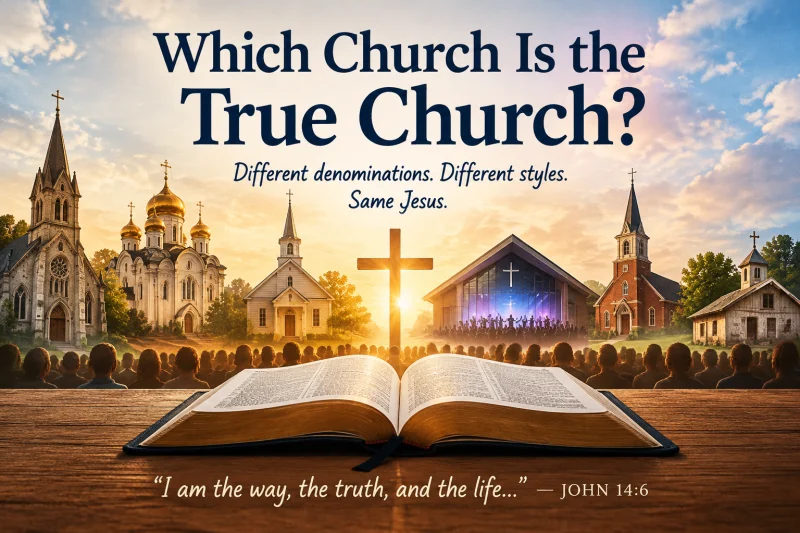
Which Church Is the True Church?
Christians have been debating the question, “Which church is the true church?” for centuries. Depending on whom you ask, you may receive completely different answers. A Roman Catholic may tell you that the Catholic Church has historical continuity going back to the apostles. An Eastern Orthodox Christian may make a similar claim while rejecting the authority of the Pope. A Baptist may tell you that the true church is any congregation that faithfully follows the Bible. A Lutheran may emphasize salvation by grace through faith. A Pentecostal Christian may focus on the active presence of the Holy Spirit. A non-denominational Christian may simply say that denominations themselves are unnecessary and that Christians should follow Jesus without adding labels.
The problem is that the New Testament does not present salvation as a contest in which human beings must correctly guess the right twenty-first-century denomination. Christianity existed long before the words Baptist, Lutheran, Methodist, Pentecostal, Presbyterian, Anglican, or even Roman Catholic were used in the way we understand them today. When the apostles spoke about the Church, they usually spoke about the collective body of believers who belonged to Jesus Christ.
“For as the body is one, and hath many members, and all the members of that one body, being many, are one body: so also is Christ.” — 1 Corinthians 12:12
“For by one Spirit are we all baptized into one body.” — 1 Corinthians 12:13
Paul makes the same point in Ephesians when he speaks about one body of believers united under one God and one Lord. The emphasis is not on hundreds of future organizational names. The emphasis is on the unity believers have through God and Christ.
“There is one body, and one Spirit... One Lord, one faith, one baptism, One God and Father of all.” — Ephesians 4:4-6
This does not mean that doctrine is unimportant. Christians should care deeply about what a church teaches, especially about the nature of God, the identity of Jesus, salvation, Scripture, and the resurrection. However, there is an enormous difference between disagreements over secondary doctrines and completely changing the identity of God or Jesus Christ. Christians can disagree about how Communion should be celebrated, whether infants should be baptized, whether worship should happen on Saturday or Sunday, whether musical instruments should be used, or how church leadership should be organized. Those disagreements may be important, but they do not automatically mean that one side has stopped being Christian.
Why Are There So Many Christian Denominations?
Christian denominations developed over many centuries because Christians lived in different countries, spoke different languages, developed different traditions, and disagreed about theology and church authority. Some divisions came from major theological disputes. Others came from politics, geography, culture, or disagreements about how churches should be governed. Eventually, Christianity developed into many traditions that often share the same basic faith in Jesus while disagreeing about how that faith should be practiced.
This can make Christianity appear hopelessly divided, but many of these divisions concern secondary questions rather than the identity of Jesus Himself. One church may baptize infants while another requires a personal profession of faith first. One church may celebrate Communion every week while another celebrates it once a month. One church may worship with an organ and ancient hymns while another uses drums, guitars, lights, and enough speakers to make the Book of Acts happen again acoustically. Those differences matter to the people practicing them, but they do not automatically create different religions.
Roman Catholicism
The Roman Catholic Church is one of the largest and oldest continuously existing Christian institutions in the world. Catholic worship is normally organized, liturgical, solemn, and centered around the Mass and Eucharist. Catholics recognize seven sacraments, including Baptism, Eucharist, Confirmation, Reconciliation, Matrimony, Holy Orders, and Anointing of the Sick. They also believe that Scripture should be understood together with Sacred Tradition and the teaching authority of the Church. The Pope, as Bishop of Rome, occupies a unique position of authority within Catholic Christianity.
For many people, Catholic worship provides a powerful sense of reverence and historical continuity. A person who enjoys silence, structured prayer, ancient rituals, stained glass, formal liturgy, and a predictable order of worship may feel completely at home in a Catholic church. The service is generally not designed around spontaneity or emotional excitement. Nobody is normally going to stop halfway through Mass because someone in the third row suddenly believes the Holy Spirit told him to take over the microphone and deliver an unscheduled forty-minute prophecy.
Catholicism also has serious controversies. Protestants have historically challenged the authority of the Pope, prayers involving Mary and the saints, purgatory, confession to priests, the role of Church tradition, and the Catholic understanding of the Eucharist. Catholics respond that these teachings developed within the historic Christian community and are compatible with Scripture when Scripture is interpreted through apostolic tradition. There have also been devastating scandals involving sexual abuse by clergy and institutional failures to deal with abusive priests appropriately. These scandals deserve serious criticism, but the sins and failures of clergy do not automatically mean that every Catholic sitting quietly in church praying to Jesus is somehow worshiping a different God.
Eastern Orthodox Christianity
Eastern Orthodox Christianity includes churches such as the Greek Orthodox, Serbian Orthodox, Romanian Orthodox, Antiochian Orthodox, and other historic Eastern churches. Orthodox worship is extremely ancient and highly liturgical. Services commonly include chanting, incense, icons, ancient prayers, fasting, and the Eucharist. Many Orthodox Christians view their church as preserving the theology and worship practices of early Christianity with fewer changes than Western Christianity.
Orthodox Christians place great importance on Scripture, the early Church Fathers, the ancient ecumenical councils, and Sacred Tradition. They do not accept the Pope as the supreme authority over all Christians. That disagreement over papal authority was one of the major issues behind the division between Eastern and Western Christianity. Protestants often criticize Orthodox practices involving icons and saints, while Orthodox Christians answer that they distinguish between worship, which belongs to God alone, and honor or veneration given to saints and sacred images.
Orthodox Christianity has also had its controversies. Nationalism and politics have sometimes become deeply intertwined with church leadership. Different Orthodox jurisdictions have disagreed over authority, territory, and political allegiance. Nevertheless, an Orthodox Christian praying to Jesus in an ancient liturgy is still participating in a form of Christianity centered on Christ, even if a Baptist walking into the service for the first time has absolutely no idea why everyone is standing, chanting, crossing themselves, and surrounded by incense.
Lutheran Christianity
Lutheran Christianity emerged from the Protestant Reformation associated with Martin Luther. One of the central teachings of Lutheranism is justification by grace through faith. Luther strongly opposed the idea that human beings could purchase or earn salvation through religious works. The foundation is that salvation is a gift from God rather than a reward for successfully completing enough religious ceremonies.
“For by grace are ye saved through faith; and that not of yourselves: it is the gift of God: Not of works, lest any man should boast.” — Ephesians 2:8-9
Lutheran worship often retains a structured and traditional style similar in certain ways to Catholic worship, although Lutheran theology is distinctly Protestant. Many Lutheran churches have formal liturgy, hymns, Communion, Scripture readings, and organized prayers. For someone who appreciates traditional worship but also strongly believes in the Protestant emphasis on Scripture and salvation through faith, Lutheranism can provide a comfortable middle ground.
Modern Lutheran churches are far from united on every issue. Different Lutheran denominations disagree significantly about biblical interpretation, sexuality, women's ordination, church authority, and social questions. Some Lutheran groups are extremely conservative, while others are considerably more progressive. This demonstrates why the name on the church sign does not always tell you everything about what the people inside actually believe.
Anglican and Episcopal Christianity
Anglican Christianity developed from the Church of England, while the Episcopal Church is one of the most familiar expressions of Anglicanism in the United States. Anglican worship often resembles Catholic worship because it uses liturgy, Communion, traditional prayers, clerical vestments, and an organized church calendar. At the same time, Anglican theology was strongly influenced by the Protestant Reformation, placing it somewhere between Roman Catholicism and many forms of Protestant Christianity.
Anglican churches traditionally emphasize Scripture, tradition, and reason. They practice baptism and Communion and generally maintain bishops as part of their church structure. Some Anglican congregations are extremely traditional and look almost Catholic in worship, while others are much more evangelical and Protestant in style. This wide variety can be confusing to outsiders, but it also shows how much diversity can exist inside a single Christian tradition.
Anglican and Episcopal churches have experienced major controversies involving women's ordination, same-sex marriage, sexuality, biblical interpretation, and disagreements between progressive and conservative branches. In some cases these disputes have caused congregations or entire church bodies to separate. Yet once again, disagreement over these questions does not erase the basic Christian belief shared by most Anglicans that Jesus Christ is Lord, died for humanity, rose from the dead, and is the center of salvation.
Baptist Churches
Baptists generally emphasize the authority of the Bible, personal conversion, individual faith in Jesus Christ, local church independence, and baptism of believers by immersion. Unlike Catholics, Orthodox Christians, Methodists, and some Lutherans, Baptists usually reject infant baptism. They argue that baptism should occur after an individual personally understands and professes faith in Christ.
Baptist worship varies enormously. Some churches are extremely traditional, with hymns, formal clothing, and long sermons. Others look almost identical to modern non-denominational churches, with contemporary music, casual clothing, large screens, guitars, and energetic preaching. What usually connects them is their emphasis on Scripture, personal faith, evangelism, and baptism after conversion.
Baptist history also contains serious controversies. The Southern Baptist Convention, for example, has had to confront its historical relationship with slavery and racism. More recently, Baptist institutions have faced investigations and criticism concerning the handling of sexual abuse accusations. Baptists also disagree among themselves over Calvinism, women pastors, politics, sexuality, spiritual gifts, and many other theological and social issues. Calling a church “Baptist” therefore tells you something about its theology, but certainly not everything about its culture, leadership, or local practices.
Methodist Churches
Methodism grew primarily from the ministry of John Wesley and emphasizes God's grace, personal faith, spiritual growth, charitable work, and practical Christian living. Methodists traditionally teach that Christianity should affect both a person's relationship with God and the way that person treats other human beings. Faith should lead to charity, service, moral improvement, and compassion.
Methodist worship can range from traditional to contemporary. One Methodist church may have an organ, choir, formal robes, and traditional hymns, while another may have guitars, drums, projection screens, and casual clothing. Methodism has historically placed a strong emphasis on preaching, prayer, Communion, and service to the community.
Modern Methodism has also gone through significant divisions, especially concerning sexuality and same-sex marriage. Conservative and progressive Methodists sometimes belong to different church bodies because of these disagreements. These controversies demonstrate that even within one denomination Christians can strongly disagree about how Scripture should be interpreted while still claiming faith in Jesus Christ.
Presbyterian and Reformed Churches
Presbyterian and Reformed churches developed from the Protestant Reformation and are strongly associated with theologians such as John Calvin. These churches generally emphasize God's sovereignty, careful biblical teaching, theological education, and orderly church government. Presbyterian churches are governed through elders rather than through a single bishop or completely independent local leadership.
One of the most famous theological controversies involving Reformed Christianity concerns predestination and free will. Calvinist theology teaches a strong view of God's sovereignty in salvation, while other Christians argue that human beings have a greater ability to freely accept or reject God's grace. Christians have been arguing about this subject for centuries, and somehow civilization has continued.
Presbyterian denominations also disagree over women's ordination, sexuality, biblical interpretation, and social issues. Some Presbyterian churches are conservative and strongly emphasize traditional doctrine, while others are progressive. Many people appreciate Reformed churches because sermons tend to focus heavily on theology and detailed biblical interpretation. Other Christians may prefer a more emotional or expressive worship experience.
Pentecostal and Charismatic Churches
Pentecostal and charismatic Christianity places strong emphasis on the Holy Spirit, spiritual gifts, prayer, healing, evangelism, and personal religious experience. Many Pentecostal churches believe that gifts described in the New Testament, such as speaking in tongues, prophecy, and divine healing, continue to operate today. Worship is often lively, emotional, musical, and spontaneous.
For some people, Pentecostal worship feels joyful and spiritually powerful. People may clap, raise their hands, pray aloud, cry, dance, or shout praises to God. Someone accustomed to a quiet Catholic Mass may walk into a Pentecostal service and wonder whether church accidentally merged with a Christian concert. The Pentecostal believer standing next to him may be wondering why the Catholic service feels like everyone is afraid to wake somebody up. Neither worship personality automatically makes one Christian more sincere than the other.
Pentecostal Christianity has also experienced major controversies. Some charismatic leaders have made questionable claims about miraculous healings or prophecy. Prosperity-gospel preachers have sometimes taught that financial donations will lead to wealth or supernatural blessings. Celebrity pastors have occasionally abused spiritual authority or accumulated enormous personal wealth. These problems should be criticized, but they should not automatically be attributed to every Pentecostal Christian or congregation. Many Pentecostal churches are ordinary Christian communities centered on Jesus, Scripture, prayer, family, and worship.
Seventh-day Adventists
Seventh-day Adventists are a Protestant Christian denomination especially known for observing Saturday as the Sabbath, emphasizing the Second Coming of Jesus, encouraging healthy living, and giving historical importance to the writings of Ellen G. White. Adventists believe that many Christian churches abandoned the biblical seventh-day Sabbath and that Saturday should still be observed as the primary Sabbath day.
Their distinctive doctrines have created controversy with other Christians. Critics often question Adventist teachings concerning the investigative judgment, the role of Ellen White, dietary practices, and Sabbath observance. Adventists respond that their beliefs are based upon Scripture and that salvation ultimately comes through Jesus Christ rather than through Sabbath keeping itself.
Whether someone agrees with Adventist theology or not, these disagreements are still recognizable theological disputes about Scripture. Christians can open the Bible, examine the arguments, compare interpretations, and decide whether they believe the Adventist position is correct. That is very different from a religious organization simply demanding that followers accept new divine figures because church leadership says so.
Non-Denominational Churches
Non-denominational churches have become extremely popular, particularly in the United States. These churches usually describe themselves simply as Christian rather than Baptist, Methodist, Presbyterian, or another traditional label. Many emphasize the Bible, personal faith in Jesus, contemporary worship, practical sermons, evangelism, and a less formal church atmosphere.
The advantage of a non-denominational church is flexibility. The disadvantage is also flexibility. A Catholic priest belongs to a massive institution with bishops and formal rules. A Presbyterian pastor operates within a larger governing system. Methodist and Lutheran pastors normally belong to denominational structures. An independent pastor may have much less external oversight. If leadership is healthy, this independence can work very well. If leadership is unhealthy, the pastor can slowly become preacher, prophet, CEO, financial director, disciplinary committee, theological authority, and apparently God's regional vice president.
For this reason, Christians should never assume that “non-denominational” automatically means “more biblical.” Some non-denominational churches are excellent. Others are personality-driven organizations built around charismatic leaders. As with every other church, the important question is what the congregation actually teaches and how its leadership behaves.
So Which Church Is Actually the True Church?
After looking at all these denominations, perhaps the question should be framed differently. Instead of asking which modern denomination possesses an exclusive claim to Christianity, Christians should ask whether a particular church actually points people toward the God revealed in Scripture and toward Jesus Christ. That is a much more important question than whether the building says Catholic, Baptist, Methodist, Lutheran, Orthodox, Pentecostal, or something else on the sign outside.
“I am the way, the truth, and the life: no man cometh unto the Father, but by me.” — John 14:6
Peter made the same point when he preached that salvation is found in Christ.
“Neither is there salvation in any other: for there is none other name under heaven given among men, whereby we must be saved.” — Acts 4:12
Those verses place Jesus at the center of salvation. They do not say that salvation comes through correctly identifying the denomination that will exist two thousand years later. Jesus did not say, “I am the way, but make sure you also select the correct church franchise from the future denominational menu.” Christianity teaches that salvation comes through Christ.
Salvation Is Through Faith
Paul makes this extremely clear when discussing grace and salvation. Christianity does not teach that human beings can purchase salvation, earn it through enough religious ceremonies, or force God to save them because they successfully completed a denominational checklist. Salvation begins with God's grace and faith in Jesus Christ.
“For by grace are ye saved through faith; and that not of yourselves: it is the gift of God: Not of works, lest any man should boast.” — Ephesians 2:8-9
Paul gives another simple description of Christian faith in Romans.
“If thou shalt confess with thy mouth the Lord Jesus, and shalt believe in thine heart that God hath raised him from the dead, thou shalt be saved.” — Romans 10:9
This does not mean obedience or good works are meaningless. Ephesians 2:10 immediately explains that believers are created in Christ for good works. Genuine faith should produce a changed life. Jesus also warned against people who merely call Him “Lord” without truly following God. Nevertheless, the foundation of Christian salvation remains God's grace received through faith, not denominational membership.
The Great Multitude in Revelation
The Book of Revelation gives us an important picture of the people who will ultimately stand before God. John does not describe a tiny collection of people belonging to one obscure organization. Instead, he sees an enormous number of redeemed people from throughout the world.
“After this I beheld, and, lo, a great multitude, which no man could number, of all nations, and kindreds, and people, and tongues, stood before the throne, and before the Lamb.” — Revelation 7:9
The following verse explains exactly where this multitude understands its salvation to come from.
“Salvation to our God which sitteth upon the throne, and unto the Lamb.” — Revelation 7:10
This passage is important because John does not describe seventeen people standing around congratulating themselves because only they discovered the correct religious organization. He describes a multitude so large that nobody could count it, drawn from nations, peoples, cultures, and languages throughout the world. Whatever theological disagreements Christians may have concerning the exact interpretation of Revelation, the image itself is clearly one of enormous numbers of redeemed people.
We should not turn Revelation 7 into a mathematical equation and claim that it proves every churchgoer, or even most churchgoers, will automatically be saved. Scripture does not give us that percentage, and Jesus Himself warns that outward religious identification does not guarantee genuine faith. Nevertheless, Revelation certainly makes it difficult to accept claims that salvation will belong almost exclusively to one tiny modern organization while billions of Christians throughout history were supposedly rejected because they failed to discover one particular ceremony, calendar calculation, or religious corporation.
When everything is finished, Jesus can decide the difficult cases. Christians have spent centuries arguing about predestination, Communion, baptism, Sabbath observance, church government, spiritual gifts, liturgy, icons, music, and almost everything else imaginable. Christ is perfectly capable of judging His own followers without requiring Christians on the internet to finish the final heavenly membership spreadsheet.
Worship Often Comes Down to Preference
Once the basic Christian foundation is established, the choice of where to worship often comes down to personal preference. Some people are naturally drawn toward quiet, solemn, structured worship. They may feel closest to God while sitting inside a Catholic or Orthodox church surrounded by ancient prayers, candles, stained glass, icons, and centuries-old traditions. Other Christians feel spiritually alive in a church filled with contemporary music, energetic preaching, raised hands, and joyful singing.
Neither personality is automatically superior. One Christian may prefer silence and contemplation. Another may want drums, guitars, and a congregation loudly singing praise to God. A third may want an hour-long Bible sermon where the pastor carefully examines every sentence in Romans. Another may prefer a shorter sermon followed by Communion. These are different ways of worshiping, not necessarily different gods.
The important issue is not whether the church has an organ or a guitar. It is not whether the congregation sits, stands, kneels, raises its hands, or occasionally gets so enthusiastic that the church drummer appears to be fighting for his life. The important question is whether the worship is genuinely directed toward God and whether the teaching remains centered on Jesus Christ and faithful to Scripture.
You Do Not Have to Agree With Every Practice
It is probably unrealistic to expect that you will agree with absolutely everything taught or practiced by any church. You may be Catholic and disagree with a particular tradition. You may attend a Baptist church and disagree with the pastor about Calvinism. You may worship with Methodists while disagreeing with a denominational position on a social issue. You may attend a Pentecostal church while remaining skeptical whenever somebody announces that God personally revealed which car another member should purchase.
Christians are human beings, and human beings disagree. A disagreement over a secondary teaching does not necessarily require you to leave a congregation that otherwise helps you worship God, study Scripture, pray, serve others, and grow spiritually. It is entirely possible to appreciate a church while disagreeing with some of its traditions or theological conclusions.
There must, however, be boundaries. A disagreement concerning baptism is not the same thing as changing the identity of God. A disagreement concerning Communion is not the same thing as declaring a modern human being to be the returned Jesus. When a religious organization claims that salvation exists only through itself, discourages questioning, elevates leaders beyond biblical authority, introduces new divine figures, or teaches a fundamentally different gospel, Christians should examine those claims very carefully.
“Beloved, believe not every spirit, but try the spirits whether they are of God.” — 1 John 4:1
Paul gives an even stronger warning about accepting another gospel simply because the person presenting it sounds spiritually impressive.
“Though we, or an angel from heaven, preach any other gospel unto you than that which we have preached unto you, let him be accursed.” — Galatians 1:8
And Then There Is WMSCOG
This brings us to a category that is very different from ordinary Christian denominational disagreement. Choosing between Catholicism, Lutheranism, Methodism, Baptists, Presbyterians, Anglicanism, or Pentecostal Christianity is one kind of theological discussion. Then the World Mission Society Church of God enters the room and apparently decides that two thousand years of Christianity was simply missing a surprise Korean sequel.
WMSCOG teaches that the Korean religious leader Ahnsahnghong was the Second Coming Christ and also teaches a doctrine known as “God the Mother,” identifying another human figure with a divine maternal role. At that point, we are no longer discussing whether the church should use grape juice or wine at Communion. We are no longer deciding between Saturday and Sunday worship, infant baptism and adult baptism, or an organ and a worship band. We have driven several exits beyond ordinary denominational disagreement and are now discussing whether modern human beings should be identified as divine.
The strange part is that Christians have spent centuries debating extremely difficult theological questions, yet the central identity of Jesus was never supposed to become a scavenger hunt. Historic Christianity teaches that Jesus Christ is the Son of God, crucified, risen, exalted, and returning. The New Testament describes His return in dramatic and visible terms rather than as another ordinary human life that believers must identify through complicated reinterpretations of prophecy.
“This same Jesus, which is taken up from you into heaven, shall so come in like manner as ye have seen him go into heaven.” — Acts 1:11
Revelation likewise describes the return of Christ as something that will not remain hidden from humanity.
“Behold, he cometh with clouds; and every eye shall see him.” — Revelation 1:7
Hebrews emphasizes the continuing identity of the same Jesus Christ rather than introducing a replacement.
“Jesus Christ the same yesterday, and to day, and for ever.” — Hebrews 13:8
So if one church uses an organ and another uses guitars, Christianity can survive. If one church baptizes infants and another waits until adulthood, Christians can study Scripture and debate it. If one congregation celebrates Communion every week and another once a month, Christianity will probably make it through the evening. But when somebody announces that a twentieth-century Korean man was secretly the returned Christ and that Christianity also needs a modern “God the Mother,” perhaps it is time to put down the denominational comparison chart and reopen the Bible.
That is not hatred toward the people inside such a group. Many members may sincerely believe they are serving God. The issue is the doctrine. Christians should examine extraordinary religious claims especially carefully because Scripture repeatedly warns about false christs, false prophets, and altered gospels.
“For there shall arise false Christs, and false prophets, and shall shew great signs and wonders.” — Matthew 24:24
A Christian therefore has every biblical reason to investigate someone who claims that a new human figure is Christ rather than accepting the claim because a Bible study presentation has enough arrows, timelines, highlighted verses, charts, and calculations to resemble a theological crime investigation board.
Even Jesus Praised and Corrected Different Churches
There is another important point that is sometimes overlooked when people argue that only one perfectly organized religious institution can be the “true church.” In the Book of Revelation, Jesus Himself addresses seven different churches in Asia Minor: Ephesus, Smyrna, Pergamum, Thyatira, Sardis, Philadelphia, and Laodicea. These were real Christian congregations, and they did not all have the same strengths, weaknesses, problems, or spiritual condition. Jesus examined each church individually, praised what was good, condemned what was wrong, warned them when necessary, and called them to repentance.
This is important because Jesus did not simply say that only one of these congregations counted as His church while the others were automatically excluded. Instead, He dealt with each congregation according to its actual condition. Some received tremendous praise. Others received praise and criticism at the same time. Some were in serious spiritual trouble. Revelation therefore gives us a very realistic picture of churches made up of imperfect human beings who sometimes get things right and sometimes get things terribly wrong.
Ephesus: Correct Doctrine but a Lost Love
The church at Ephesus is a perfect example. Jesus praised its members because they worked hard, showed patience, and refused to blindly believe people who claimed to be apostles. They actually tested religious leaders and discovered that some of them were false.
“Thou hast tried them which say they are apostles, and are not, and hast found them liars.” — Revelation 2:2
That sounds like a strong church. They cared about truth and refused to tolerate false authority. Yet Jesus immediately told them that something important was missing.
“Nevertheless I have somewhat against thee, because thou hast left thy first love.” — Revelation 2:4
In other words, being correct about doctrine did not automatically make Ephesus spiritually perfect. A church can expose false teachers, defend Scripture, and win theological arguments while becoming cold, bitter, or spiritually empty. Jesus praised what Ephesus did correctly while telling them to fix what they had lost.
Smyrna: Poor by Human Standards, Rich Before God
Smyrna received a very different message. These Christians were suffering persecution and material poverty, yet Jesus described them as spiritually rich. Their church may not have looked successful by worldly standards, but Christ judged their situation differently.
“I know thy works, and tribulation, and poverty, (but thou art rich).” — Revelation 2:9
Instead of condemning Smyrna, Jesus encouraged its members to remain faithful during suffering.
“Be thou faithful unto death, and I will give thee a crown of life.” — Revelation 2:10
This is an important reminder that the largest, richest, or most impressive church is not automatically the healthiest church. A small congregation struggling financially may look insignificant to the world while being spiritually precious to Christ.
Pergamum: Faithful in Some Areas, Wrong in Others
The church at Pergamum gives us another fascinating example. Jesus praised the believers because they continued confessing His name even under severe pressure and persecution.
“Thou holdest fast my name, and hast not denied my faith.” — Revelation 2:13
That is serious praise. Yet Jesus then criticized the same congregation because some people within it were accepting false teachings.
“But I have a few things against thee, because thou hast there them that hold the doctrine of Balaam.” — Revelation 2:14
Again, Jesus did not treat the congregation as completely perfect or completely worthless. He recognized their faithfulness while demanding correction where they were wrong. This is much closer to the reality of Christian churches than the idea that one organization has absolutely everything correct while every other congregation is completely false.
Thyatira: Love and Service but False Teaching
Jesus praised the church at Thyatira for charity, service, faith, patience, and increasing good works. This congregation clearly had many positive qualities.
“I know thy works, and charity, and service, and faith, and thy patience, and thy works; and the last to be more than the first.” — Revelation 2:19
Yet Christ immediately rebuked the same church for tolerating false teaching associated with a woman symbolically called Jezebel.
“Notwithstanding I have a few things against thee, because thou sufferest that woman Jezebel... to teach and to seduce my servants.” — Revelation 2:20
Jesus did not pretend that their good works erased their theological problems, but He also did not pretend that their theological problems erased everything good they were doing. He evaluated the church honestly. That is probably a useful approach for Christians today as well.
Sardis: An Excellent Reputation but Spiritually Dying
The church at Sardis received one of the strongest warnings. Apparently it had a reputation for being alive and successful. Other people may have looked at Sardis and thought it was an excellent church. Jesus saw something very different.
“I know thy works, that thou hast a name that thou livest, and art dead.” — Revelation 3:1
This should be a warning to modern Christianity. A church can have thousands of members, a beautiful building, professional music, excellent marketing, popular social-media accounts, bestselling books, and a pastor with perfect teeth while being spiritually unhealthy. Jesus was not impressed by the public reputation of Sardis. He examined what was actually happening inside.
Even then, Jesus did not judge every person inside Sardis identically. He specifically recognized that some individuals remained faithful.
“Thou hast a few names even in Sardis which have not defiled their garments; and they shall walk with me in white.” — Revelation 3:4
This is another important lesson. Even within a troubled church, Christ recognized faithful individuals. That should make Christians careful about condemning every believer simply because of the denomination or institution he or she attends.
Philadelphia: Small but Faithful
The church at Philadelphia received one of the most positive messages. Jesus acknowledged that the congregation had limited strength but praised its members because they remained faithful to His word and did not deny His name.
“Thou hast a little strength, and hast kept my word, and hast not denied my name.” — Revelation 3:8
Philadelphia was apparently not powerful by human standards, yet Jesus praised it. This is a reminder that a small church with twenty-five faithful people may be spiritually healthier than a massive religious organization with twenty-five thousand members. Christianity is not a popularity contest, and Jesus does not appear to be counting Instagram followers before deciding whether a congregation belongs to Him.
Laodicea: The Famous Lukewarm Church
Then there is Laodicea, probably the most famous of the seven churches. This congregation believed that it was prosperous and spiritually secure, but Jesus described it as lukewarm.
“I know thy works, that thou art neither cold nor hot: I would thou wert cold or hot.” — Revelation 3:15
“So then because thou art lukewarm, and neither cold nor hot, I will spue thee out of my mouth.” — Revelation 3:16
The Laodiceans apparently thought they were doing wonderfully. Jesus had a very different evaluation. Yet even after giving such a harsh warning, Christ still called them to repentance rather than presenting them as people beyond hope.
“As many as I love, I rebuke and chasten: be zealous therefore, and repent.” — Revelation 3:19
That verse is especially important because Jesus directly connects correction with love. The fact that Christ rebuked a church did not necessarily mean that every believer inside it was rejected. Sometimes the correction itself showed that Christ still cared about the congregation and wanted its members to change.
What the Seven Churches Tell Us Today
The seven churches in Revelation show something remarkably practical. Churches can have different strengths, different weaknesses, different personalities, and different spiritual problems. One church can be strong in doctrine but weak in love. Another can be suffering but deeply faithful. Another can have wonderful charitable works while tolerating bad teaching. Another can have an amazing reputation while being spiritually dead. Another can be small and apparently insignificant while receiving the praise of Christ.
That sounds surprisingly similar to Christianity today. One church may provide excellent Bible teaching but have terrible community life. Another may have beautiful worship but shallow sermons. Another may be wonderful at helping the poor while being confused about certain doctrines. Another may be extremely traditional and reverent. Another may be loud, joyful, and energetic. Churches are communities of imperfect human beings, and the New Testament never gives us a picture in which every local congregation is flawless.
It is also important to be accurate here. The seven churches of Revelation were local first-century congregations, not modern denominations such as Baptists, Catholics, Methodists, or Pentecostals. Revelation 2 and 3 therefore does not prove that every modern denominational division is ideal or that doctrine does not matter. What it does show is that Jesus recognized multiple Christian congregations and dealt with each one individually. He praised what was good, condemned what was wrong, and called believers to repentance and faithfulness.
That makes far more biblical sense than claiming that Jesus recognizes only one modern religious corporation while every other Christian congregation on earth is automatically false. Revelation itself shows Jesus speaking to multiple churches and essentially telling them, “You are doing this correctly, you are doing this incorrectly, continue here, repent there, remain faithful here, and fix this problem over there.” Apparently Christianity had barely entered the first century before Jesus was already handing out spiritual performance reviews.
Most importantly, every message points believers back toward Christ. Jesus does not praise churches because they have the coolest name, the largest membership list, the most impressive building, or the most complicated prophecy chart. He examines faithfulness, love, perseverance, truth, repentance, and obedience. That should remain the standard today.
Christians Should Feel Free to Visit Other Churches
There is nothing wrong with visiting another Christian denomination. In fact, doing so can be spiritually and intellectually healthy. A Baptist can attend Catholic Mass. A Catholic can visit a Methodist congregation. A Methodist can worship with Presbyterians. A Lutheran can attend an Anglican church. A Christian traveling away from home can walk into another Christian church simply because he wants to worship, pray, hear Scripture, or spend time with other believers.
Visiting another church does not require abandoning your own beliefs. You can participate respectfully, observe how other Christians worship, and appreciate traditions that may be unfamiliar to you. You might discover the beauty of silence inside a Catholic church, the ancient prayers of Orthodoxy, the detailed Bible teaching of a Baptist congregation, the hymns of a Lutheran service, or the joyful music of a Pentecostal church.
Once Christians understand that denominations are not necessarily separate religions, they become much freer to recognize one another as brothers and sisters in Christ. Paul criticized factional thinking because believers were beginning to identify themselves more strongly with individual teachers than with Christ.
“Every one of you saith, I am of Paul; and I of Apollos; and I of Cephas; and I of Christ. Is Christ divided?” — 1 Corinthians 1:12-13
That question could easily be asked today. One person says, “I am Catholic.” Another says, “I am Baptist.” Someone else says, “I am Lutheran,” “I am Methodist,” or “I am Pentecostal.” Those descriptions can be useful because they explain theological traditions, but they should never become more important than belonging to Christ. Jesus did not rise from the dead wearing a Baptist name tag. He was not carrying a Methodist membership card. Christianity is ultimately centered on Christ, not on the institutional labels Christians developed afterward.
Do Your Research Before Joining Any Church
Although denomination should not become an idol, Christians should still research a congregation before joining it. Read the church's statement of faith. Learn about its history. Find out what it teaches about God, Jesus Christ, salvation, Scripture, baptism, Communion, and the resurrection. Ask whether the pastor can be questioned. Find out how financial decisions are made and whether leadership has meaningful accountability.
Pay attention to how the church treats people who disagree. Healthy churches may strongly defend their beliefs, but they should not need to frighten members into staying. Be cautious if a group teaches that leaving the organization means losing salvation, that outsiders are spiritually dangerous, that questioning leadership is rebellion against God, or that only its own members possess the truth. Those are important warning signs because Christianity places faith in Christ, not absolute dependence upon a religious corporation.
Acts 17 gives one of the best examples of healthy religious thinking. The Bereans listened to Paul's preaching and then checked what he said against Scripture.
“They received the word with all readiness of mind, and searched the scriptures daily, whether those things were so.” — Acts 17:11
Think about how significant that is. These people were checking the teaching of an apostle against Scripture. Paul did not condemn them for questioning him. Scripture actually praises them for doing it. If an apostle could be fact-checked, your local pastor can survive it too. If a religious leader tells you that questioning his interpretation is equivalent to questioning God, that should not make you stop asking questions. It should make you start asking more.
The True Church Is Larger Than a Denomination
In the end, the “true church” is probably much larger than any one denomination wants to admit. The New Testament describes believers as the body of Christ. Christians may worship differently, organize churches differently, interpret secondary doctrines differently, and come from radically different cultures while still placing their faith in the same Lord.
Some Christians kneel when they pray, while others stand. Some raise their hands, while others remain completely still. Some sing hymns written three hundred years ago, while others sing worship songs written three months ago. Some worship inside enormous cathedrals, while others meet in storefront churches, rented halls, living rooms, or small chapels. None of those things determines whether Jesus is present in a person's faith.
The church building is not Christ. The denomination is not Christ. The pastor is not Christ. The Pope is not Christ. The church founder is not Christ. The worship band is not Christ. The liturgy is not Christ. These things may help Christians worship, learn, organize themselves, and grow spiritually, but they are not the object of Christian salvation. Jesus Christ is the center of Christianity.
That is why Christians should be careful about turning denominational preference into a salvation requirement. You may believe Catholic worship is the most beautiful. Another person may believe Baptist preaching is the clearest. Someone else may prefer Pentecostal worship because it feels joyful and alive. Another person may find peace in Orthodox liturgy. These preferences can matter personally without becoming universal requirements for salvation.
Revelation ultimately gives Christians a picture far greater than any denomination. It describes believers from throughout the world standing together before God and the Lamb.
“A great multitude, which no man could number, of all nations, and kindreds, and people, and tongues.” — Revelation 7:9
They are not described as standing in separate Baptist, Catholic, Lutheran, Methodist, Orthodox, Presbyterian, and Pentecostal sections with velvet ropes between them. They are standing before God and before the Lamb. That should tell Christians something important. Christianity ultimately points beyond denominations toward God and Christ.
Choose a church where you can sincerely worship God, follow Jesus, study Scripture, pray, serve other people, and grow in faith. Feel free to visit other Christian churches and learn from other believers. Compare teachings with Scripture and never surrender your ability to think simply because a religious leader speaks confidently or claims exclusive authority. You do not need to agree with every secondary practice of a congregation in order to worship alongside other Christians.
Christians may never settle every argument in this life. They will probably continue debating baptism, Communion, predestination, Sabbath observance, worship styles, spiritual gifts, church government, and countless other subjects until Christ returns. Revelation itself shows that Jesus dealt with churches individually, praising some qualities, rebuking others, and calling imperfect congregations to repentance rather than pretending that the Christian world consisted of one flawless local organization.
Fortunately, final judgment has not been assigned to the Catholic Church, the Baptist Convention, the Pentecostals, the Presbyterians, the Methodists, the Lutherans, the Orthodox patriarchs, internet theologians, Facebook Bible experts, or whoever happens to be shouting the loudest in the comment section. According to Christianity, that responsibility belongs to Jesus Christ. He knows the heart, He knows who truly belongs to Him, He knows which churches were faithful and which were not, and He is perfectly capable of sorting it all out.
التعليقات
اترك تعليقًا
No account is required. Your email address is required for payment/moderation records but is never displayed publicly. Comments are not eligible for approval until the $5.00 Stripe payment is verified, and payment does not guarantee approval.