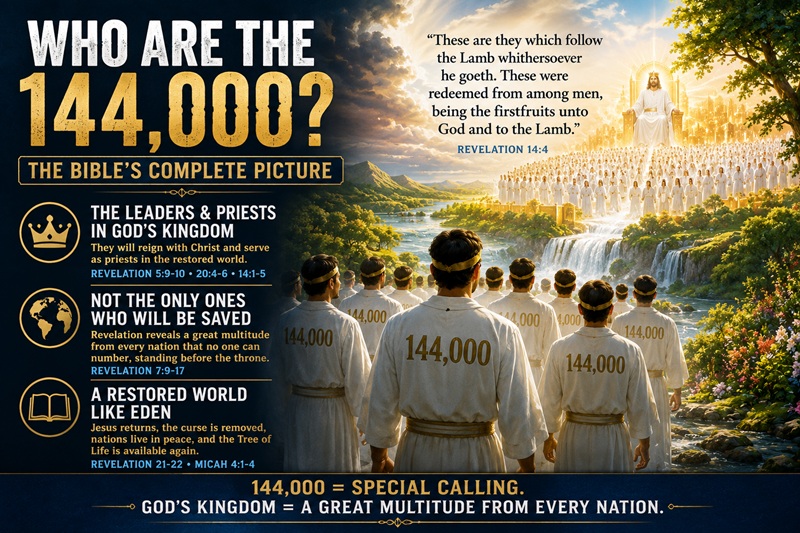
144,000 in the Book of Revelation - Their true role
The 144,000 mentioned in the Book of Revelation are often misunderstood as though they are the only people who will be saved, resurrected, or permitted to live in God's future Kingdom. That interpretation does not fit the complete picture presented in Revelation. When Revelation 7, Revelation 14, Revelation 20, Revelation 21, Revelation 22, and the prophetic picture in Micah 4 are read together, the 144,000 appear to represent a specially chosen group with a particular role in God's restored Kingdom. They are not presented as the total number of God's people.
Revelation first introduces the 144,000 in Revelation 7:3-8, where they are described as servants of God who are pre-selected and sealed. Revelation 14:1-5 later shows the 144,000 standing with the Lamb on Mount Zion. They bear the name of the Lamb and His Father, follow the Lamb wherever He goes, and are described as "firstfruits unto God and to the Lamb."
That word firstfruits is extremely important. Firstfruits are not the entire harvest. They are the first portion of a much larger harvest that follows. This gives us an important clue that the 144,000 are a special group among God's people rather than the total number of people who will receive salvation.
The 144,000 Are Not the Only People Who Will Be Saved
One of the clearest problems with teaching that only 144,000 people will be saved is found immediately after the 144,000 are mentioned. In Revelation 7:9-17, John sees another group standing before God.
"After this I beheld, and, lo, a great multitude, which no man could number, of all nations, and kindreds, and people, and tongues, stood before the throne, and before the Lamb, clothed with white robes, and palms in their hands."
Notice the difference. John is given an exact number for the first group: 144,000. Then he sees another group that is so large that no man could number it.
These people are not described as rejected or outside God's Kingdom. They are standing before the throne of God and before the Lamb. They are wearing white robes and holding palm branches. They praise God for salvation, and Revelation explains that they have washed their robes and made them white in the blood of the Lamb.
Revelation 7 goes even further. God shelters them, they serve Him, they are led to living waters, and God wipes away every tear from their eyes. These are clearly redeemed people.
That alone shows why the 144,000 cannot simply be interpreted as the only people who will receive eternal life. Revelation itself describes an enormous additional population of faithful people immediately after describing the 144,000.
The 144,000 Appear to Have a Special Role in God's Kingdom
The better way to understand the 144,000 is as a specially selected group within the much larger population of God's redeemed people. They appear to have a special responsibility in the Kingdom that Jesus establishes.
Revelation repeatedly connects faithful servants of God with leadership, priesthood, judgment, and rulership under Christ. Revelation 5:9-10 describes people redeemed by the blood of the Lamb and says that God has made them kings and priests and that they will reign. Revelation 20:4-6 similarly describes faithful people participating in the resurrection and reigning with Christ. They are specifically called "priests of God and of Christ."
This provides an important framework for understanding the 144,000. Rather than representing every human being who will ever be resurrected, they can reasonably be understood as a specially prepared group of servants, leaders, priests, and rulers who serve under Jesus Christ in God's restored Kingdom.
A kingdom can contain millions of citizens while still having people who hold special positions of responsibility. Priests are not the entire population. Leaders are not the entire population. Judges are not the entire population. Likewise, the existence of the 144,000 does not mean that everyone outside that number is destroyed.
The 144,000 appear to be people chosen for a particular purpose within God's government.
The Bible Ends With the Restoration of the World
Another important part of this subject is understanding what happens after Jesus returns. Christianity is sometimes presented as though God's final plan is simply to remove everyone from the earth and take them somewhere else forever. But Revelation presents something much bigger: the restoration of creation itself.
The Bible begins with humanity living in Eden. There is no death, no curse, and humanity has access to the Tree of Life. Sin enters the world, humanity loses access to Eden, and death becomes part of human existence.
Then look at the final chapters of Revelation.
In Revelation 21 and 22, God again dwells with humanity. The curse is removed. Death, sorrow, crying, and pain are ultimately defeated. The river of the water of life flows from the throne of God and the Lamb. Most importantly, the Tree of Life appears again.
The Bible begins with Eden lost and ends with an Eden-like world restored.
That means God's Kingdom should not simply be understood as people floating somewhere in heaven forever. Revelation describes a restored creation under the rule of God and Jesus Christ.
Micah 4 Helps Explain the Future Kingdom
This is where Micah 4 becomes extremely important. Micah describes the last days as a time when God's government is established and people from many nations come to learn His ways.
"And many nations shall come, and say, Come, and let us go up to the mountain of the LORD... and he will teach us of his ways, and we will walk in his paths."
Micah then describes something remarkable. God judges among the nations, warfare ends, and people live peacefully and securely.
"They shall beat their swords into plowshares, and their spears into pruninghooks: nation shall not lift up a sword against nation, neither shall they learn war any more."
This clearly describes a world containing nations and peoples. It is not a picture of only 144,000 human beings existing after the return of Christ.
There are nations. There are people learning God's ways. There are people living under God's government. There is peace instead of warfare. This fits naturally with Revelation's picture of Christ ruling, God's servants reigning with Him, and an enormous multitude of redeemed people living under God's authority.
The 144,000 and the Great Multitude Are Not the Same Number
This distinction is important because Revelation itself makes it.
First John hears the number 144,000. Then he sees a great multitude that nobody can number.
If God intended to teach that exactly 144,000 people would be saved, Revelation 7 would be a very strange way to explain it. Immediately after presenting a numbered group, the book introduces another faithful group that cannot even be counted.
The simplest way to understand the passage is that the 144,000 have a special calling while the great multitude represents a much larger population belonging to God.
This is also consistent with Revelation 14 calling the 144,000 "firstfruits." Firstfruits imply that something follows them. You do not call something the firstfruits if it represents the entire harvest.
Resurrection Is Not Limited to 144,000 People
People also need to separate the subject of the 144,000 from the broader biblical teaching concerning resurrection. Revelation describes resurrection, judgment, nations, servants of God, priests, rulers, and an innumerable multitude. Reducing all of that to exactly 144,000 people ignores huge portions of the book.
The 144,000 are therefore better understood as having a particular position or responsibility rather than representing the total number of people who will ever live again.
They may function as leaders, priests, servants, or rulers under Christ as God's Kingdom is established. Revelation repeatedly describes God's faithful servants reigning with Christ, while other passages clearly demonstrate that a much larger population exists within the restored world.
Read the Entire Book of Revelation
The biggest mistake people make with Revelation is building entire doctrines around one verse, one number, or one symbol while ignoring everything surrounding it. Revelation has to be read as one complete prophetic picture.
When you do that, the sequence becomes much easier to understand. Jesus returns. The dead are raised. God's enemies are defeated. God's servants receive positions within His Kingdom. Christ rules. The nations come under righteous government. Creation is restored. The curse is removed. The Tree of Life returns. Humanity once again lives under the direct authority of God.
Within that restored order, the 144,000 appear to have a special calling. Revelation 14 describes them as following the Lamb wherever He goes and calls them firstfruits to God and the Lamb. Revelation elsewhere describes faithful servants as kings, priests, and people who reign with Christ.
That gives us a much more complete picture of who the 144,000 may be: a specially selected group serving in positions of responsibility in God's restored Kingdom after Jesus returns.
The Bigger Picture
The message of Revelation is much bigger than the number 144,000. God's plan is not limited to one small numbered group. Revelation itself describes a multitude so enormous that nobody can count them.
The 144,000 are numbered. The great multitude is not.
The 144,000 are called firstfruits. Firstfruits imply a larger harvest.
The 144,000 have a special relationship with the Lamb. Revelation also describes kings, priests, servants, nations, and an innumerable population worshiping God.
When Revelation 7, Revelation 14, Revelation 20-22, and Micah 4 are read together, the picture becomes much clearer. The 144,000 are not the only people who will be resurrected or receive life in God's Kingdom. They appear instead to be a specially chosen group with an important role in the government, priesthood, and service of the Kingdom established by Jesus Christ.
The Bible begins with Eden. Humanity loses Eden through sin. Jesus returns, death and evil are defeated, creation is restored, and Revelation ends with humanity once again having access to the Tree of Life.
The 144,000 are part of that restored Kingdom. They are not the entire Kingdom.
Comments
Leave a comment
No account is required. Your email address is required for payment/moderation records but is never displayed publicly. Comments are not eligible for approval until the $5.00 Stripe payment is verified, and payment does not guarantee approval.