Are Most Surgeries Really Necessary?
Note & Medical Disclaimer: Since I am not a doctor, I will not provide any pathological as well as any diagnostic details. I highly advise you to do your own research or preferably consult with your own doctor on what each body part does and details regarding each procedure as well as any possible injury. Also, don’t start googling anything either because it will all lead to cancer and that you have about six months to live. I once had a case where the client thought she had terminal bone cancer because her MRIs revealed that she had bone spurs in her spine. She used to call me every day and cry on the phone for an hour. More specifically, this chapter is intended to explore the long-term effects of such procedures and whether they are medically necessary.
A notable case where the surgery did help:
I once had a new case come in. The client left his prior attorney due to poor service. Not sure what the issue was, but he kept insisting that he needed some kind of serious procedure done on his knee. The doctor that he saw prior to coming to us recommended some kind of serious three-part procedure on his knee, which entailed a bone or cartilage grafting. I wasn’t even sure which procedure because the prior doctor never returned our calls or the client’s calls for months. Bone grafting is a procedure that uses a transplanted bone to repair the damaged bone of the patient. The client had a complete derangement of the knee and his X-Rays showed that he had loose bodies, malalignment, and chondral damage. Unfortunately, because our client was a victim of a previous gunshot wound, he could not do any MRIs to do more thorough studies of any possible soft tissue damage.
Initially, I personally did not care which doctor he used, but as mentioned before, the prior doctor neither returned my phone calls nor the client’s calls. I asked the physical therapy place that we know and trust to refer him to a different orthopedic doctor for a second opinion and possibly fix his knee because he had legitimate traumatic injuries. Within a few days, the client had an appointment with an amazing orthopedic surgeon. After reviewing the X-rays, the doctor recommended an exploratory endoscopy. If the doctor found something, he would fix it on the spot.
During surgery, the doctor noticed an ACL tear, meniscus tear, as well as extensive chondral damage. There is a distinction between chondromalacia, which is degenerative, and trauma-induced chondral damage. The client clearly had severe trauma-induced tibial chondral damage. The doctor performed the meniscectomy to repair the torn meniscus, ACL repair, as well as extensive chondral repair without the need for any bone grafting. This type of injury has no 100% recovery, and it was not a permanent solution because down the line, he would be at high risk for arthritis and would never retain 100% use of his knee, but overall, he retained 75% use of his knee. His range of motion limitations was only between 10–15%, which is not bad at all, compared to 70% before the surgery.
About 99.9% of personal injury attorneys try to convince their clients to undergo a surgical procedure to bring a higher value to their case. Especially when they see a large policy. But on the other hand, there is a subset of people who would sell their kidneys for more money. In fact, many people do! As if they know what the deal is. They all seem to know the possible prospects of a much higher settlement offer if they do some kind of surgical procedure. I am not a doctor, but I will go over the three most common surgical procedures as well as the pros and cons of each procedure, which most clients report back to me.
Since everyone is different and everyone’s injuries are different, I will not specifically mention an overall assessment on whether it is more of a pro or con. Any surgical procedure can have a long-lasting life effect on your body and should not be taken lightly. There can be significant risks such as infection, blood clots, permanent nerve damage, and slow recovery due to chronic inflammation or chronic underlying health issues. These types of decisions should be done with the doctor who would be performing the procedure. It is highly advisable to get a second opinion before deciding to go forward with any surgical procedure.
The most common surgical procedures that clients get are meniscectomies, ACL repairs, shoulder ligament repairs, and discectomies. On more extreme measures, I have seen some attorneys who work with dirty doctors who convince clients to undergo spinal fusions. It makes me sick just thinking about it. After the procedures, half the clients start calling me crying and complaining about all the pain that they are having or how much worse it has gotten because of the surgery. This is why I wrote this stupid book. Specifically for this chapter. Not just to vent on how much I hate this job but to also educate some of you greedy idiots who decide to go under the knife just for a few extra bucks. So, here is a breakdown of the type of common injuries that may or may not require a surgical procedure.
Cervical Spine (Your Neck) / Thoracic Spine (Middle of back) / Lumbar Spine (Lower Back):
What is a Spine? A spine is made up of bones or vertebrae and in between each vertebra is a cartilage-like disc filled with cerebral fluid. The discs are specifically designed to allow your bones to move, flex, absorb shock, and hold the vertebrae together. The disc is made up of hard cartilaginous tissue. Similar to the cartilage in your bone.
Note: There is also Sacral Spine and Coccyx. Aside from random fractures because someone fell on their ass, it is very rare you would see any injuries to those parts of the spine, so I will not even mention them.
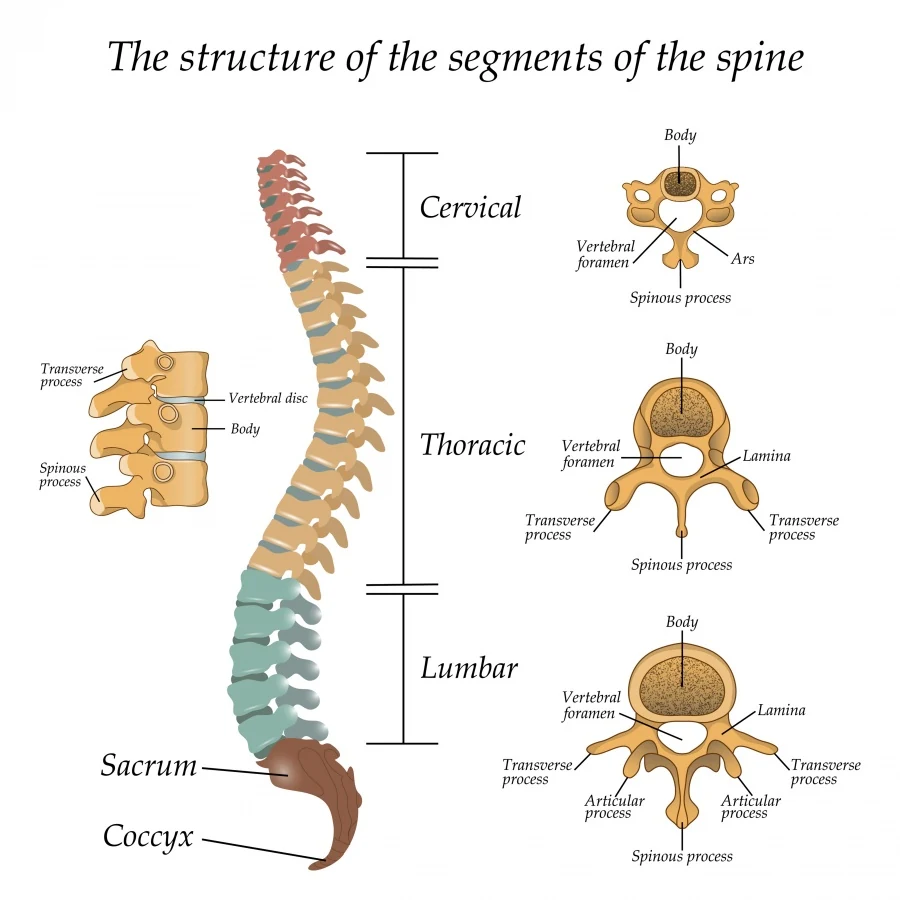
(Credit: )
Common Type of Injuries:
Disc Bulge – A damaged disc may slightly protrude or bulge out. This generally would not create any pain because most disc bulges do not touch or impinge the nerve roots.
Disc Herniation – A disc herniation is a protruding disc that has ruptured. Most pain comes from an impingement of the nerve.
Degenerative findings:
These types of injuries may be degenerative and not accident-related but could be exacerbated by the accident, which means that it could make your pre-existing injuries hurt a lot more.
Disc Desiccation – A common degenerative disc disease, which dehydrates the disc. It keeps the disc from Flexing.
Fun Fact: Disc desiccation progresses with age. As the discs dehydrate, you begin to shrink and become shorter with age.
Scoliosis – Scoliosis is a condition, which curves your spine. The problem with scoliosis is that you are prone to get disc bulges and herniations as well as other degenerative issues.
Why it hurts: Whether it is a disc bulge or disc herniation, the pain mostly comes when the protruding disc is touching or pressing into the nerve.
Surgical Procedures:
Percutaneous Discectomy – A minimally invasive surgical procedure that relieves the pressure of the nerve roots
Complete Discectomy – A procedure, which requires some vertebrae removal to gain better access to the damaged disc.
Annuloplasty – a minimally invasive outpatient procedure that repairs the ruptured or torn annulus (not ruptured anus).
Laminectomy – a surgical procedure in which a surgeon removes part of all of the vertebral bone (lamina).
Spinal Fusion – A procedure, which requires a rod or screws to fuse two or more vertebrae together.
Shoulders (Soft Tissue Surgery):
Shoulder surgeries are usually the most lucrative of all soft tissue surgeries. The bare minimum value of a shoulder surgery case may be as little as $70, 000, assuming there are no issues with causality. That’s if the doctor performs basic debridement of a tear. The value goes exponentially higher if the doctor must perform decompression and even more if the doctor must create anchors to support loose tissue.
Knees (Soft Tissue Surgery):
There are various soft knee injuries, which may result from a car accident, which may or may not require a surgical procedure. Most No-Fault doctors will agree that meniscal repair surgery is crucial in recovery, while most prestigious doctors who have an extensive history in academics and research claim that meniscal repair surgery may not be required for most meniscus tear injuries. Some of these procedures include but are not limited to meniscectomies, ACL repair, synovectomy, which is mostly attributed to synovitis, which is a degenerative issue, and chondroplasty, which is required to repair (somewhat) chondromalacia, which is also a degenerative issue.
All Bone Injuries:
Generally, when there is a significant injury such as a broken bone or displaced fracture, most of the surgical procedures are ORIFs (Open Reduction Internal Fixation). This is when the doctor inserts rods and screws to hold your bones together until they heal. ORIF cases are worth hundreds of thousands of dollars. I once settled a tibia fracture case, which resulted in an ORIF surgery for $600, 000 before we even had to file a bill of particulars.
Conclusion: Most of my cases take an average of six months to a year to settle. For the most part, I don’t see any long-term complications from soft tissue surgeries. However, at least 60% of all long-term litigated cases clients complained of some kind of lingering pain or discomfort, which the client claimed was not there BEFORE the surgery. It makes me wonder why they did the surgery in the first place if that was the case. I never advise clients to do any type of procedure if they are not in pain. A lot of my prior bosses have though. I don’t know how they even sleep at night.